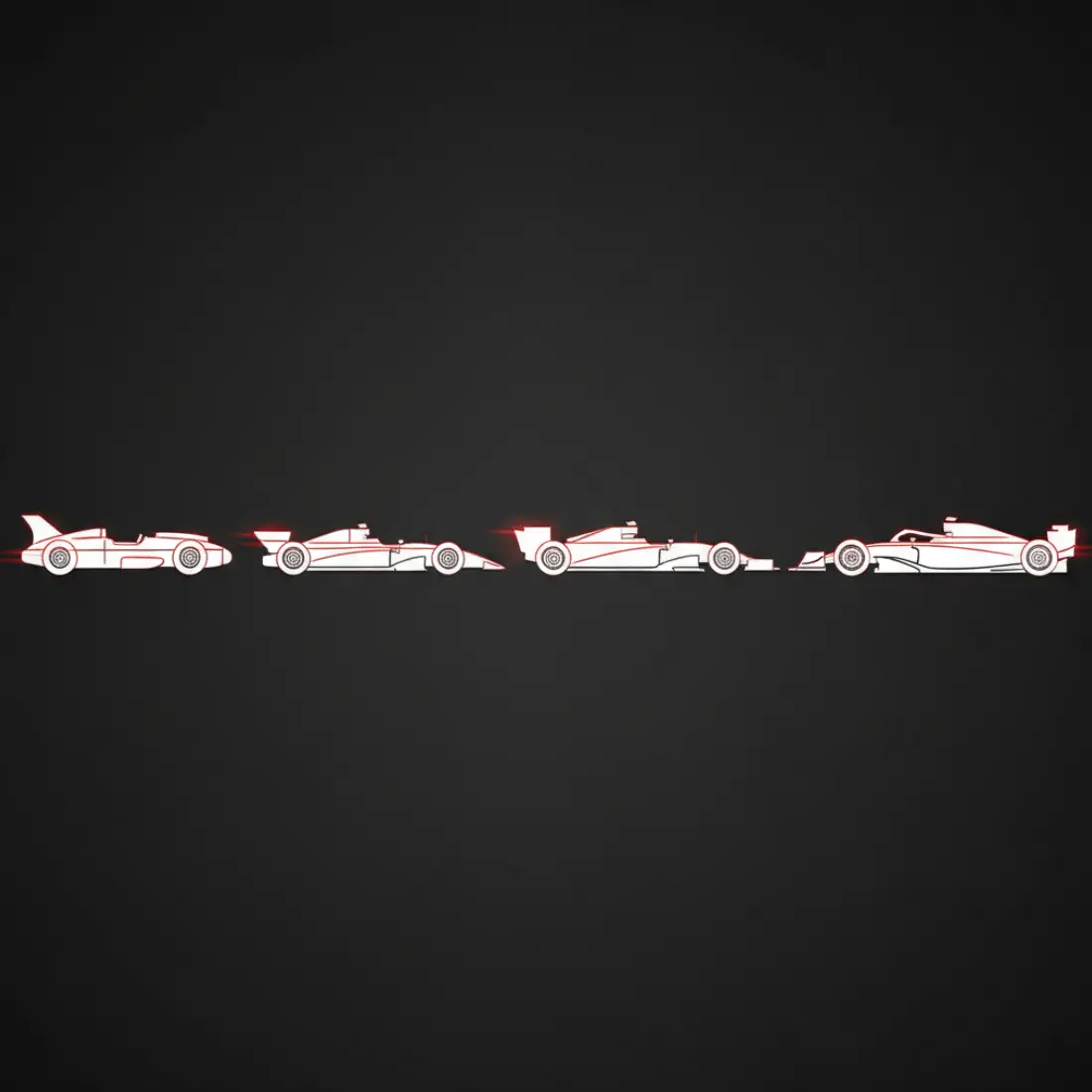
The Evolution of Formula 1 Car Design: From the 1950s to Today
A visual journey through seven decades of engineering brilliance, from front-engined roadsters to the active aero machines of 2026.
Formula 1 is the greatest engineering arms race in sport. Since the first World Championship in 1950, the cars have been reinvented time and again — each decade bringing radical new ideas that would have seemed impossible to the generation before. What started as modified road cars with virtually no aerodynamic consideration has evolved into 770kg carbon fibre machines capable of generating more downforce than their own weight, powered by hybrid engines that are the most thermally efficient ever built.
For fans of Formula 1, understanding how these cars have changed isn’t just a history lesson — it’s a way to appreciate why every curve, wing, and air duct on a modern F1 car exists. And for those who love the visual side of the sport, the changing shapes of these machines across the decades make for some of the most iconic imagery in all of motorsport.
Let’s take a decade-by-decade look at how Formula 1 car design has evolved.
The 1950s: Raw Power, Minimal Protection
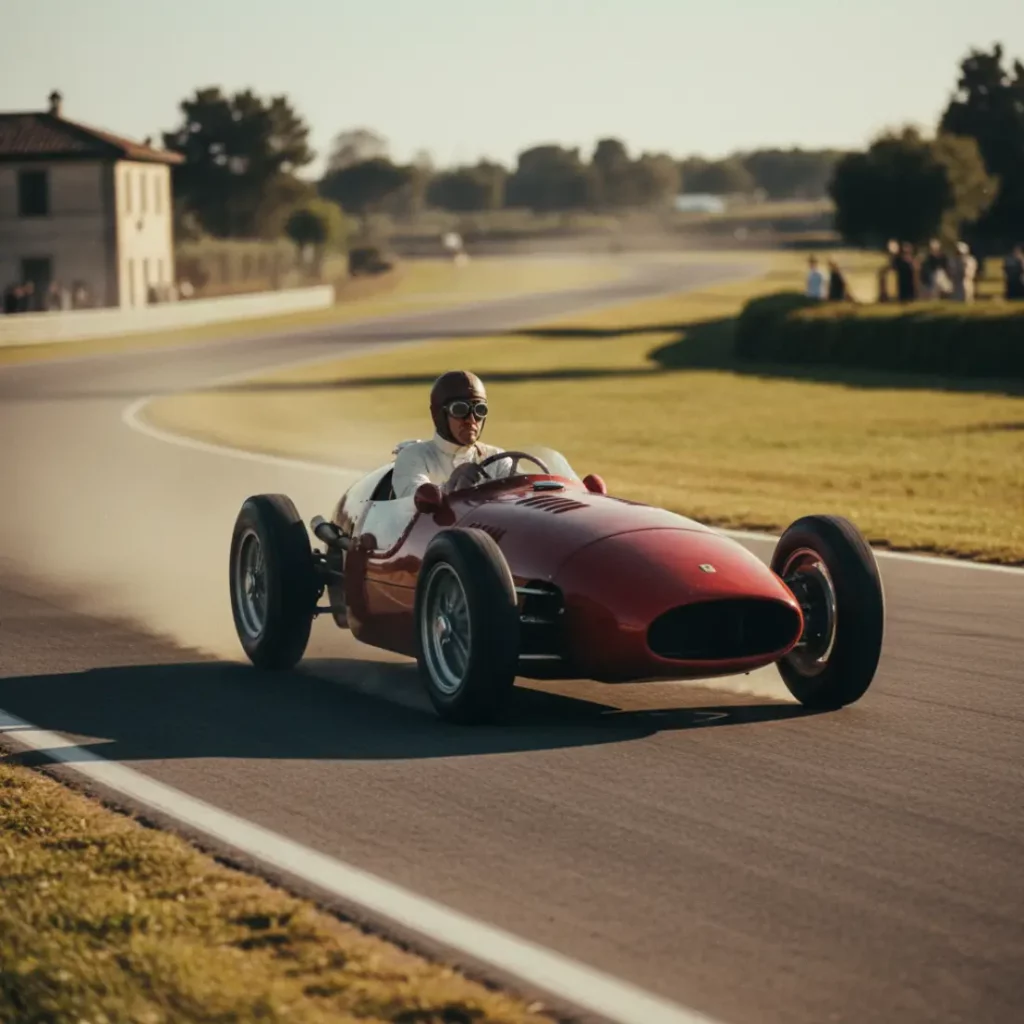
The first Formula 1 cars were a world away from anything we’d recognise today. When the inaugural World Championship kicked off at Silverstone in 1950, the grid was filled with front-engined machines that were essentially adapted pre-war Grand Prix cars. Drivers sat upright in open cockpits, wore cloth helmets and goggles, and had almost no safety equipment whatsoever.
These early cars were powered by 1.5 to 2.5-litre engines producing around 250–300 horsepower. The chassis were built from simple steel tube frames, and aerodynamics played virtually no role — the focus was entirely on straight-line speed and mechanical grip from the tyres. Teams like Ferrari, Maserati, and Alfa Romeo dominated, and the cars had a beautiful, almost fragile elegance to them.
The most significant shift of the decade came towards the end. Cooper shocked the establishment by placing the engine behind the driver rather than in front — a layout that would completely transform the sport. By the late 1950s, the rear-engined revolution was underway, proving that a lighter, more balanced car could beat a more powerful front-engined rival.
Legends like Sir Jackie Stewart — who would go on to win three World Championships — entered a sport that was as dangerous as it was thrilling.
The 1960s: The Monocoque Revolution
The 1960s brought one of the most important structural innovations in motorsport history: the monocoque chassis. Pioneered by Lotus with the Lotus 25, this design replaced the traditional tubular spaceframe with a single shell that acted as both the body and the structural core of the car. The result was dramatically improved rigidity with significantly less weight.
By mid-decade, every competitive F1 car had adopted a mid-engine layout, and engines were growing more powerful. V8 and V12 units were now producing upwards of 400 horsepower, and the cars were faster than ever. But the most visible change came towards the end of the decade — the arrival of wings.
Teams began experimenting with aerodynamic devices mounted on tall struts above the car, designed to push the car down onto the track and improve grip through corners. These early wings were crude and often dangerous — several spectacular failures forced the FIA to step in and regulate their design — but they marked the birth of the aerodynamic era that defines F1 to this day.
Safety, however, remained a grave concern. The decade saw numerous fatalities, and it would take the tireless campaigning of drivers like Jackie Stewart to push the sport towards meaningful safety reforms. The Flying Scot used his enormous influence to demand barriers, fireproof suits, and better medical facilities at circuits worldwide.
The 1970s: Ground Effect and Turbo Power
If the 1960s planted the seeds of the aerodynamic revolution, the 1970s saw it bloom into something extraordinary. Two innovations defined this era: ground effect and the turbocharged engine.
Ground effect was the brainchild of Lotus engineer Peter Wright and designer Colin Chapman. The concept was deceptively simple — by shaping the underside of the car like an inverted wing and sealing the edges with flexible skirts, the airflow beneath the car created a massive low-pressure zone that effectively sucked the car onto the track. The Lotus 79, driven to the 1978 World Championship by Mario Andretti, was the purest expression of this idea, and its cornering speeds were unlike anything the sport had seen.
Meanwhile, Renault introduced the first turbocharged F1 engine in 1977. While naturally aspirated engines of the era produced around 500 horsepower, turbos would eventually push past 1,000 horsepower by the early 1980s. Teams like Ferrari were quick to adopt the technology.
This was also a decade of wild experimentation. The Tyrrell P34, a six-wheeled car with four small front wheels, demonstrated just how far engineers were willing to go for a competitive edge. The FIA eventually stepped in to rein in the more extreme designs, but the 1970s had permanently changed what an F1 car could look like and how fast it could go.
Drivers who defined this era — including the legendary Niki Lauda in his iconic Ferrari 312T and the fearless Gilles Villeneuve — became symbols of an era where bravery and engineering genius were inseparable.
The 1980s: The Turbo Era and Carbon Fibre
The 1980s were perhaps the most dramatic decade in F1 history. Turbocharged engines reached staggering levels of power — in qualifying trim, some units were producing well over 1,000 horsepower from just 1.5 litres. The sheer speed of these cars was breathtaking, but the reliability was often questionable, and the sport became a fascinating tug-of-war between outright power and mechanical endurance.
The other defining innovation of this era was the introduction of carbon fibre composite chassis. McLaren’s MP4/1, designed by John Barnard and introduced in 1981, was the first F1 car to feature a carbon fibre monocoque. The material was lighter and stronger than aluminium, and it offered far better crash protection. Within a few years, every team on the grid had followed suit, and carbon fibre remains the material of choice to this day.
Ground-effect skirts were banned by the FIA in 1983 over safety concerns, forcing teams to find downforce through more conventional wings and bodywork. The flat-bottom rule was introduced, fundamentally changing the aerodynamic philosophy of the cars.
By the end of the decade, the FIA also banned turbocharged engines entirely, bringing in a new era of 3.5-litre naturally aspirated power. The McLaren MP4/4, powered by a Honda turbo engine in its final year of eligibility in 1988, won 15 of 16 races — one of the most dominant seasons in the sport’s history, driven by Ayrton Senna and Alain Prost. Senna’s partnership with McLaren-Honda remains one of the most celebrated in F1 history.
Formula 1 Car Design: Decade by Decade
How power, weight, speed, and innovation have evolved across 75+ years of F1
| Era | Engine | Power | Weight | Top Speed | Key Innovation | Iconic Car |
|---|---|---|---|---|---|---|
| 1950s | 2.5L Inline-4 / V8 | ~290 bhp | 600 kg | ~280 km/h | Mid-engine layout | Maserati 250F |
| 1960s | 1.5L – 3.0L V8 / V12 | ~400 bhp | 530 kg | ~300 km/h | Monocoque chassis & wings | Lotus 49 |
| 1970s | 3.0L V8 / V12 + turbo | ~500 bhp | 575 kg | ~315 km/h | Ground effect aerodynamics | Lotus 79 |
| 1980s | 1.5L Turbo V6 | ~1,000+ bhp | 540 kg | ~350 km/h | Carbon fibre monocoque & turbo | McLaren MP4/4 |
| 1990s | 3.0L V10 | ~800 bhp | 595 kg | ~340 km/h | Active suspension & traction control | Williams FW14B |
| 2000s | 3.0L V10 → 2.4L V8 | ~900 bhp | 600 kg | ~370 km/h | CFD & advanced aero | Ferrari F2004 |
| 2014–21 | 1.6L Turbo V6 Hybrid | ~950 bhp | 752 kg | ~375 km/h | Hybrid PU (MGU-K + MGU-H) | Mercedes W11 |
| 2022–25 | 1.6L Turbo V6 Hybrid | ~950 bhp | 798 kg | ~370 km/h | Ground effect return & 18″ wheels | Red Bull RB19 |
| 2026+ | 1.6L Turbo V6 Hybrid (50/50 split) | ~950 bhp | 770 kg | TBC | Active aero & overtake mode | New era begins |
The 1990s: Electronics, Refinement, and Global Expansion
The 1990s represented a period of extraordinary technical refinement. Semi-automatic gearboxes, traction control, active suspension, and increasingly sophisticated aerodynamics pushed lap times lower and lower. The cars were becoming incredibly complex pieces of technology.
However, the FIA was growing concerned that driver aids were reducing the importance of driver skill. In 1994, a raft of electronic systems were banned — including active suspension and traction control — in an effort to put more emphasis on the human behind the wheel. This decision was tragically followed by the deaths of Ayrton Senna and Roland Ratzenberger at Imola that same year, events that shocked the sport and led to a wholesale overhaul of safety regulations.
Engines during this period were typically 3.0-litre V10s, producing around 700–800 horsepower by the end of the decade. Teams began using wind tunnels as a critical part of their development programmes, and the level of aerodynamic sophistication grew enormously. Carbon fibre was now being used not just for the chassis but for bodywork, wings, and an increasing number of structural components.
The decade also saw F1 expand into a truly global sport, with new races in Asia and the Middle East bringing the spectacle to millions of new fans.
The 2000s: V10 Screams and Aerodynamic Arms Race
The early 2000s are remembered by many fans as a golden age for F1 engine noise. The 3.0-litre V10 engines — revving to nearly 20,000 RPM — produced a spine-tingling scream that has never been matched. Power outputs reached around 900–1,000 horsepower from units that weighed barely 100 kilograms.
Aerodynamics became increasingly complex, with multi-element front wings, intricate barge boards, and elaborate diffusers becoming standard. Teams poured enormous resources into wind tunnel testing and, increasingly, computational fluid dynamics (CFD). The cars were faster than ever, but the dirty air they produced made overtaking extremely difficult, a problem that would plague the sport for years.
The FIA introduced several regulation changes to try to improve the racing spectacle, including reducing engine capacity to 2.4-litre V8s from 2006. Cost containment also became a growing concern as budgets spiralled out of control.
Fernando Alonso became the sport’s youngest-ever double World Champion during this period, beginning a career that would span over two decades and see him become one of the most celebrated F1 legends of all time. You can also find a stunning pencil sketch portrait of the Spanish maestro in our collection.
The 2010s: The Hybrid Revolution
The most significant technical shift since the turbo era arrived in 2014 with the introduction of 1.6-litre turbocharged V6 hybrid power units. These combined an internal combustion engine with two energy recovery systems — the MGU-K (recovering kinetic energy from braking) and the MGU-H (recovering heat energy from exhaust gases). The result was the most thermally efficient engines in automotive history, converting over 50% of fuel energy into usable power.
The cars were quieter than their V8 predecessors, which divided opinion among fans, but the technology was undeniably impressive. Hybrid power units produced around 950 horsepower while using roughly 30% less fuel than the previous generation.
This era was dominated by Mercedes, who won eight consecutive Constructors’ Championships from 2014 to 2021. Lewis Hamilton — widely regarded as one of the greatest drivers ever — claimed six of his record-equalling seven World Championships during this period, cementing his status as an all-time great.
Safety took another massive leap forward in 2018 with the introduction of the halo device — a titanium structure mounted above the cockpit to protect drivers from large debris and impacts. Initially criticised on aesthetic grounds, the halo has since been credited with saving multiple lives and is now universally accepted as one of F1’s most important safety innovations.
Sebastian Vettel, who had won four consecutive titles with Red Bull from 2010 to 2013, and Charles Leclerc, who emerged as Ferrari’s exciting young hope, were among the F1 drivers who defined this transformative decade.
2022–2025: The Return of Ground Effect
The 2022 regulations represented the biggest aerodynamic reset in a generation. Inspired by the ground-effect principles first explored by Lotus in the 1970s, the new rules replaced complex above-body aerodynamics with sculpted underbody tunnels designed to generate the majority of the car’s downforce from beneath the floor.
The goal was simple but ambitious: reduce the dirty air produced by the car ahead so that following cars could race more closely and overtake more easily. Front wings were simplified, rear wings were redesigned, and the overall look of the cars changed dramatically — they became wider, heavier, and more sculpted.
DRS (Drag Reduction System) remained as an overtaking aid, allowing drivers within one second of the car ahead to open a flap on their rear wing along designated straights.
This era saw Max Verstappen and Red Bull Racing assert extraordinary dominance, with Verstappen claiming multiple World Championships. Meanwhile, Lando Norris and McLaren emerged as genuine title contenders, and Carlos Sainz proved himself as a race-winning force at Scuderia Ferrari.
2026 and Beyond: Active Aero, Lighter Cars, and a New Era
Formula 1 is about to undergo what many insiders are calling the biggest regulation overhaul in the sport’s history. From 2026, virtually every aspect of the car will change — dimensions, weight, aerodynamics, power unit architecture, fuel, and safety structures.
Smaller, Lighter, More Agile: The 2026 cars will have a shorter wheelbase (reduced by 200mm to 3,400mm), be 100mm narrower, and weigh 30kg less — coming down to a minimum of 770kg. Narrower tyres will further reduce drag. The result should be more nimble, responsive machines that put a greater premium on driver skill.
Active Aerodynamics: Perhaps the most revolutionary change is the introduction of movable front and rear wings. In designated zones, drivers can switch between “Corner Mode” (maximum downforce) and “Straight-Line Mode” (minimum drag for higher top speeds). This replaces DRS entirely and gives drivers far more strategic control over their car’s performance.
Overtake Mode and Boost Mode: When within one second of a rival, drivers can deploy “Overtake Mode” — an extra burst of electrical energy to help initiate a pass. There’s also “Boost Mode,” which allows drivers to deploy maximum power from the engine and battery at any point on the lap, adding a layer of tactical decision-making that hasn’t existed before.
Revamped Power Units: The hybrid system moves to a roughly 50/50 split between internal combustion and electric power. The MGU-H has been removed to simplify the system and attract new manufacturers — and it’s worked. Audi, Ford (partnering with Red Bull Powertrains), and a returning Honda will all join the grid alongside Ferrari and Mercedes. Cars will also run on fully sustainable fuel.
Enhanced Safety: A two-stage front impact structure, stronger roll hoops rated to withstand 20g forces (up from 16g), and improved side intrusion protection all reflect F1’s ongoing commitment to keeping drivers safe.
As Lewis Hamilton himself put it, 2026 will place the driver at the centre of the action like never before, with energy management, system deployment, and tactical awareness becoming just as important as outright speed.
Why F1 Car Design Makes for Incredible Wall Art
The evolution of Formula 1 car design isn’t just a story of engineering progress — it’s a visual story. Each era has its own unmistakable aesthetic, from the elegant simplicity of the 1950s front-engined cars to the aggressive, sculpted forms of today’s ground-effect machines. The liveries of iconic teams like Ferrari, McLaren, and Aston Martin have become as recognisable as any brand in the world.
That’s what makes Formula 1 posters such a popular choice for bedrooms, offices, man caves, and living rooms. Whether you’re drawn to the romanticism of Ayrton Senna’s McLaren era, the modern dominance of Max Verstappen, or the classic vintage F1 aesthetic, there’s an F1 poster that captures the moment perfectly.
At Poster Print Base, our sports poster collection features a growing range of premium F1 prints — from legendary drivers like Niki Lauda, Gilles Villeneuve, and Sir Jackie Stewart to today’s stars like Lewis Hamilton, Charles Leclerc, and Lando Norris.
Every poster is printed on premium 250gsm glossy, fade-resistant photo paper with high-resolution digital printing, available in A3, A2, and A1 sizes with free UK delivery.
Browse the full Formula 1 poster collection →
Love motorsport? Explore our full range of sports posters or discover more racing art and motorsport prints at Poster Print Base.