Max Verstappen’s Dominance: The Records He’s Broken
Four titles. 71 wins. A season so dominant it may never be matched. Here’s how Max Verstappen rewrote the Formula 1 record books — and why he isn’t finished yet.
There are drivers who win races. There are drivers who win championships. And then there is Max Verstappen — a driver who has systematically dismantled almost every meaningful record in the 75-year history of Formula 1.
By the time Verstappen lined up on the grid for the 2025 Abu Dhabi Grand Prix at just 28 years old, he had already won four consecutive world championships, taken 71 Grand Prix victories, and set records that many in the paddock believe will never be broken. His 2023 season alone — 19 wins from 22 races — stands as the single most dominant campaign in the sport’s history, a performance so absurdly complete that it rewrote entire chapters of the F1 history books in a single year.
But Verstappen’s story isn’t just about numbers. It’s about a prodigious talent who arrived in Formula 1 as the youngest driver in history and evolved into the most ruthlessly effective competitor the sport has ever seen. Here’s the full picture of his dominance — record by record.
The Youngest of Everything
Verstappen didn’t just arrive in Formula 1 early — he arrived before anyone thought it was possible. When he started the 2015 Australian Grand Prix for Toro Rosso at 17 years and 166 days old, he shattered Jaime Alguersuari’s record as the youngest driver to start a World Championship race — by almost two years.
But that was merely the prelude. At the 2016 Spanish Grand Prix, Verstappen was promoted from Toro Rosso to Red Bull Racing mid-season — and won on his very first race for the team. At 18 years and 228 days, he became the youngest driver in history to win a Formula 1 Grand Prix, a record that still stands and may never be beaten given the current Super Licence age requirements.
That afternoon in Barcelona was the moment Formula 1 realised it wasn’t watching a promising teenager — it was watching a future great.
Max Verstappen — Record Breaker
Every major F1 record held by the four-time World Champion heading into 2026
| Record | Verstappen | Previous Record | Year |
|---|---|---|---|
| 📊 Single-Season Records (2023) | |||
| 19 | 15 — Verstappen (2022) |
2023 | |
| 86.4% | 75.0% — Ascari (1952) |
2023 | |
| 10 | 9 — Vettel (2013) |
2023 | |
| 575 | 454 — Verstappen (2022) |
2023 | |
| 290 pts | 155 pts — Vettel (2013) |
2023 | |
| 1,003 | 739 — Vettel (2011) |
2023 | |
| 6 | 5 — Ascari (1952) / Schumacher (2004) |
2023 | |
| 12 | 9 — Mansell (1992) / Vettel (2011) |
2023 | |
| 21 | 18 — Verstappen (2021) |
2023 | |
| 🏆 Career Records | |||
| 1,004 | 998 — Hamilton (2018–2020) |
2022–23 | |
| 39 | 37 — Schumacher (2000–2002) |
2022–23 | |
| 71 | 3rd all-time (Hamilton 105, Schumacher 91) |
Ongoing | |
| ⚡ Youngest Records | |||
| 17y 166d | 19y 125d — Alguersuari (2009) |
2015 | |
| 18y 228d | 22y 26d — Vettel (2008) |
2016 | |
Four Consecutive Championships (2021–2024)
Verstappen’s path to his first title in 2021 was anything but straightforward. He and Lewis Hamilton fought one of the most intense, controversial, and dramatic championship battles in the sport’s history — a war that raged across 22 races and was only settled on the final lap of the final race in Abu Dhabi.
Verstappen won 10 races that season, took 10 pole positions, and reached the podium 18 times. He arrived at the last race level on points with Hamilton and, following a late safety car, overtook the Mercedes on the final lap to claim his first World Drivers’ Championship.
What followed was complete domination.
2022 saw Verstappen win 15 races — breaking the all-time record of 13 shared by Michael Schumacher (2004) and Sebastian Vettel (2013). He sealed his second title with four races to spare.
2023 was the most dominant season in Formula 1 history. Period. We’ll come to the individual records below, but the headline figures speak for themselves: 19 wins from 22 races, 575 points, a 290-point margin over his nearest rival. He clinched his third consecutive title with six Grands Prix still remaining — matching Schumacher’s record from 2002 for the earliest championship-clinching moment in a season.
2024 was a different kind of dominance. As Red Bull’s performance advantage evaporated in the second half of the season, Verstappen held his nerve while McLaren closed in. His rain masterclass in Brazil — winning from 17th on the grid — was the defining moment. He won nine races and secured his fourth consecutive title in Las Vegas, becoming only the fifth driver in history to win four or more championships, joining Schumacher (7), Hamilton (7), Juan Manuel Fangio (5), and Vettel (4).
The 2023 Season: A Statistical Supernova
Verstappen’s 2023 campaign deserves its own section because no driver in F1 history has ever produced anything like it. It wasn’t just dominant — it was historically unprecedented across virtually every measurable statistic.
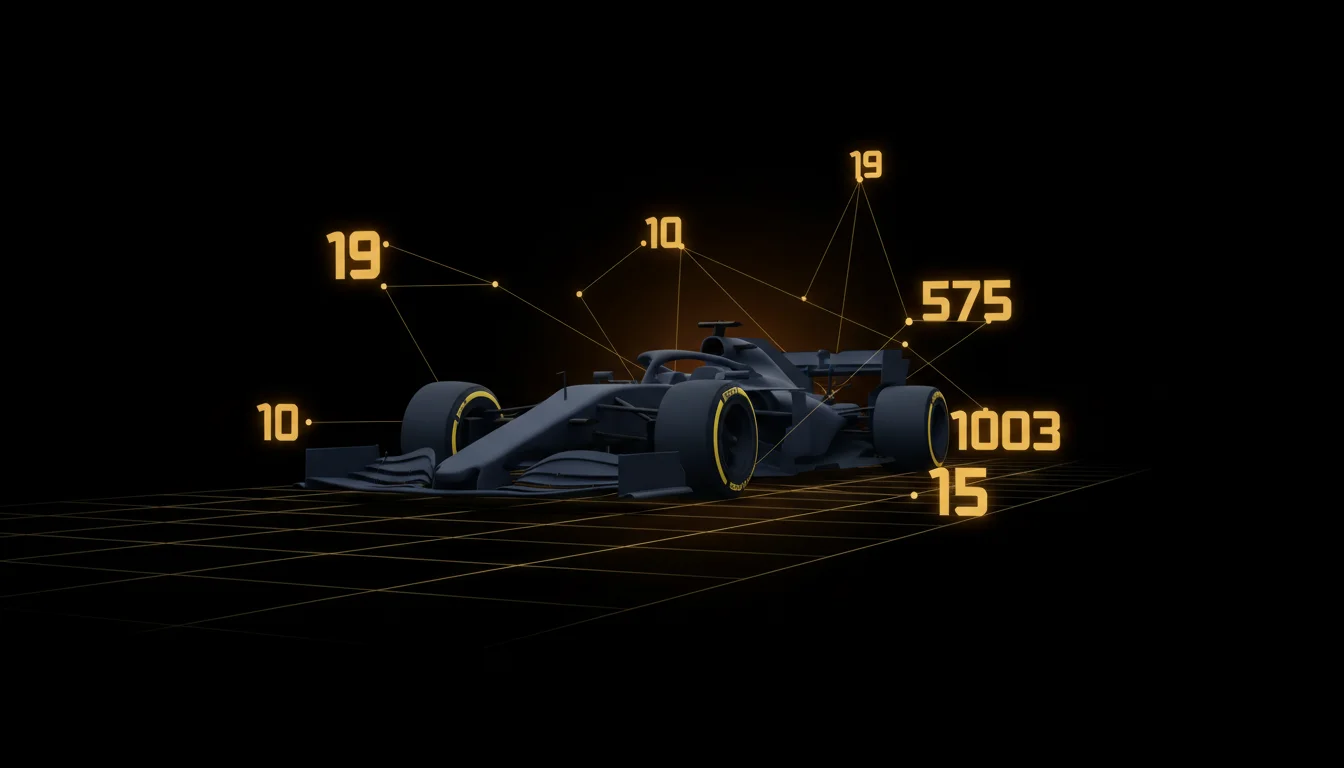
19 Wins in a Single Season
Verstappen won 19 of 22 Grands Prix in 2023, obliterating his own record of 15 set the year before. To put that into perspective: only 17 drivers in the entire history of Formula 1 have won more than 19 races across their entire careers. Verstappen did it in a single year.
86.4% Win Rate in a Season
By winning 19 of 22 races, Verstappen posted the highest single-season win percentage ever recorded. The previous benchmark was Alberto Ascari’s 75% from 1952 — a record that had stood for over 70 years. Verstappen didn’t just edge past it; he smashed it by more than 11 percentage points.
10 Consecutive Victories
From Miami in May to Monza in September, Verstappen won 10 races in a row — breaking Vettel’s record of nine consecutive wins from 2013. Only Carlos Sainz’s victory in Singapore stopped Verstappen from potentially winning every single race after the opening four rounds.
575 Points — Most in a Single Season
The maximum possible points haul from 22 races (excluding sprints) is 620. Verstappen scored 575 — a staggering 92.7% return. He eclipsed his own record of 454 from 2022.
290-Point Championship Margin
Verstappen beat his teammate Sergio Pérez by 290 points — the largest margin between first and second in championship history. The previous record was Vettel’s 155-point advantage over Fernando Alonso in 2013, which now looks almost modest by comparison.
1,003 Laps Led — Most in a Season
Verstappen led over 1,000 laps in 2023, becoming the first driver in history to break the four-figure barrier. The previous record was Vettel’s 739 from 2011. Verstappen’s total was also higher than the combined laps led by Ayrton Senna and Alain Prost during their legendary 1988 season.
6 Hat-Tricks in a Season
A hat-trick in F1 means pole position, race win, and fastest lap in the same Grand Prix. Verstappen achieved this six times in 2023 — in Spain, Austria, Britain, Japan, Qatar, and Abu Dhabi — beating the record of five shared by Ascari (1952) and Schumacher (2004).
12 Wins from Pole in a Season
Every single pole position Verstappen took in 2023, he converted into a victory. All 12. The previous record was nine, shared by Nigel Mansell (1992) and Vettel (2011).
Career Records — The Bigger Picture
Beyond the extraordinary 2023 season, Verstappen’s career statistics place him among the greatest drivers who have ever lived — and he’s still only 28.
71 Grand Prix Victories
As of the end of the 2025 season, Verstappen sits third on the all-time winners’ list behind Hamilton (105) and Schumacher (91). Given his age and the expanding calendar, overtaking Schumacher’s tally within the next three to four seasons is a realistic possibility — and Hamilton’s record is not out of reach.
48 Pole Positions
Verstappen’s qualifying speed is extraordinary. He matched Senna’s record of eight consecutive pole positions during his dominant run and continues to add to his tally every season.
127 Career Podiums
With at least another five to seven seasons theoretically ahead of him, Verstappen’s podium count will almost certainly climb into the all-time top three.
Four Consecutive Championships
Only Schumacher (five, 2000–2004) has won more consecutive titles. With Verstappen narrowly missing a fifth in 2025 — losing to Lando Norris by just two points in a breathtaking season-long battle — the question of whether he can match or exceed Schumacher’s streak remains very much alive heading into the new regulations era in 2026.
1,004 Consecutive Points
Between the 2022 Emilia Romagna Grand Prix and the end of the 2023 season, Verstappen scored points at 33 consecutive races — surpassing Hamilton’s record of 998 consecutive points scored between 2018 and 2020.
The 2025 Comeback — Nearly the Greatest
If 2023 was about pure domination, 2025 was about something different entirely — resilience, racecraft, and the kind of never-say-die attitude that separates the truly great from the merely excellent.
Red Bull entered 2025 on the back foot. While McLaren had developed the fastest car on the grid, Verstappen’s machinery was no longer the benchmark. He finished second in the season-opening Australian Grand Prix, but as Lando Norris and Oscar Piastri shared victories between them through the first half of the year, the points gap grew.
A crash with George Russell at Barcelona and a spin behind the safety car at Silverstone — rare errors from a driver known for his precision — compounded the issue. By the Hungarian Grand Prix, Verstappen sat ninth in the standings at the summer break, a staggering 104 points behind championship leader Piastri. Most pundits had written off his title defence.
What followed was one of the great second-half surges in championship history. Verstappen won the Japanese Grand Prix from pole with what many observers called one of the greatest qualifying laps in modern F1. He won at Imola after a stunning first-lap overtake. Victory in Austin closed the gap dramatically — and when both McLarens were disqualified from the Las Vegas Grand Prix for excessive plank wear after Verstappen had already won the race, the deficit collapsed.
By the final race in Abu Dhabi, Verstappen had clawed 104 points back to just 16. He dominated the weekend — pole position, fastest lap, and a commanding 12-second victory. But Norris’s third-place finish was just enough to secure the McLaren driver’s maiden title — by the agonising margin of just two points.
Verstappen finished 2025 with eight victories — the most of any driver that year — and his season was widely described as one of the finest individual campaigns in recent F1 history, even without the championship to show for it. Red Bull team principal Christian Horner called it Verstappen’s “greatest season as a racing driver,” and even rival teams acknowledged that no other driver on the grid could have come that close from that far behind. It was a reminder that raw statistics don’t always capture the full story of a driver’s greatness.
Beyond the Numbers — What Makes Verstappen Different
Records tell you what a driver has achieved. They don’t always tell you how. Verstappen’s greatness isn’t just about the wins — it’s about the manner in which they’ve come.
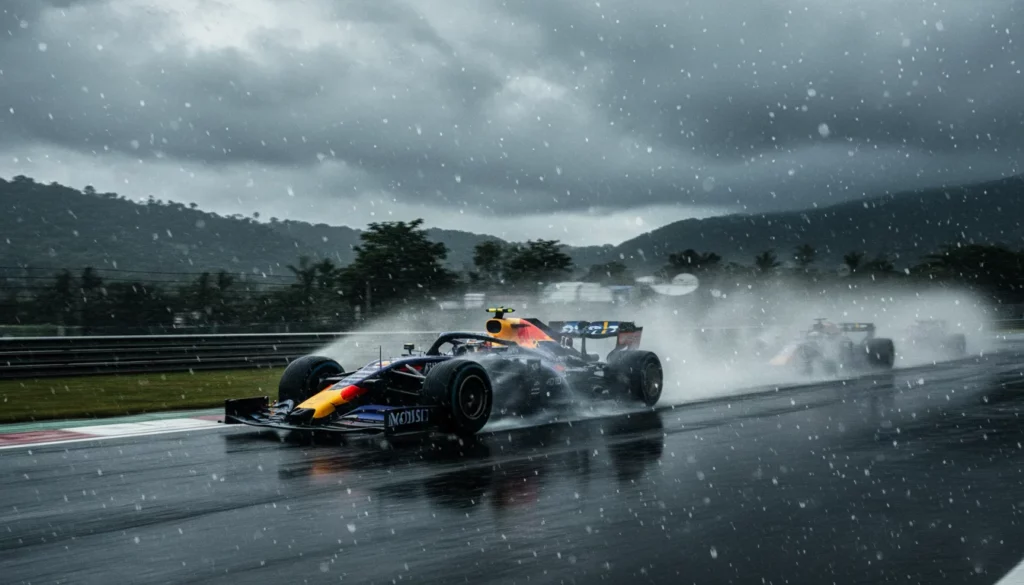
His ability in wet conditions is perhaps the most obvious example. The 2024 Brazilian Grand Prix — winning from 17th on the grid in torrential rain, passing cars as though they were standing still — recalled Senna’s famous drives at Donington in 1993 and Monaco in 1984. When the conditions are at their worst, Verstappen is at his best.
Then there’s his racecraft. Verstappen’s overtaking is aggressive but calculated — he commits to moves that other drivers wouldn’t attempt and makes them stick. His defensive driving, once criticised as overly robust in his earlier years, has evolved into a tool of surgical precision. When Verstappen defends a position, he forces the following driver into impossible choices.
His qualifying speed is another dimension. Verstappen doesn’t just set fast laps — he conjures them from nowhere. His pole position at the 2025 Japanese Grand Prix, where he put the Red Bull on pole despite Ferrari and McLaren appearing faster all weekend, was described by BBC Sport as a lap that many F1 observers regarded as one of the greatest in the sport’s history.
And perhaps most importantly, his mentality. Verstappen approaches every single race — whether he’s leading the championship by 200 points or trailing by 100 — with exactly the same intensity. He races to win. Every lap, every session, every weekend. That relentlessness is what produces record-breaking seasons, and it’s what makes him such a compelling figure to watch.
For Verstappen, racing isn’t a career — it’s a compulsion. He spends his evenings competing in online sim racing events with Team Redline, sometimes streaming into the early hours of the morning before Grand Prix weekends. In 2025, he even ventured onto the Nürburgring Nordschleife under a pseudonym, setting unofficial GT3 lap records in testing. The man simply cannot stop competing.
How Verstappen Compares to the All-Time Greats
Verstappen’s place in Formula 1 history is already secured. But where does he rank among the legends?
The numbers alone put him in elite company. At 28, he has more race wins than Senna managed in his entire career (41). He has more championships than Alonso (2), more wins than Mansell (31), and more pole positions than Niki Lauda (24) — drivers who are universally regarded as all-time greats.
The most natural comparison is with Schumacher, who also dominated an era so thoroughly that records seemed to fall every weekend. Schumacher’s five consecutive titles (2000–2004) remain the benchmark — Verstappen came within two points of matching it in 2025. Schumacher’s career total of 91 wins seemed untouchable until Hamilton surpassed it; at Verstappen’s current trajectory, he could overtake Schumacher before he turns 32.
Then there’s Hamilton himself. The seven-time champion’s 105 victories and seven titles represent the mountain Verstappen is climbing. Their 2021 title battle — the most intense in modern F1 history — remains the defining rivalry of Verstappen’s career so far. When Hamilton moved to Ferrari for 2025 alongside Charles Leclerc, it was partly because he recognised that Verstappen and Red Bull had become the force to beat. That in itself says everything about the Dutchman’s standing.
The debate over whether Verstappen has surpassed Schumacher and Hamilton will rage on for decades. What is beyond question is that no driver in the history of Formula 1 has ever dominated a single season the way Verstappen dominated 2023 — and the fact that he followed it with a title won primarily through skill and determination in 2024, and then nearly snatched a fifth consecutive crown in 2025, only strengthens the case.
What’s Next — 2026 and the New Era
The 2026 season brings the biggest regulation changes in a generation. New power units, dramatically different car designs, and active aerodynamics will reshape the competitive order entirely. For Verstappen, it’s both a risk and an opportunity.
Red Bull will run with a new partner for Isack Hadjar alongside Verstappen — a fresh dynamic after years alongside Pérez. The team’s ability to produce a competitive car under the new regulations will determine whether Verstappen can challenge for a fifth title or whether the likes of Norris, Leclerc, and Hamilton remain the ones to beat.
History suggests that the truly great drivers — Fangio, Jackie Stewart, Prost, Schumacher, Hamilton — have always found ways to adapt to new eras. Verstappen’s contract with Red Bull runs until 2028, giving him at least three seasons to prove he can dominate under a completely different set of rules.
If his track record is anything to go by, the rest of the grid should be worried.
The Records at a Glance
Here’s a summary of the key records Verstappen holds heading into 2026:
Single-season records: most wins (19), highest win percentage (86.4%), most consecutive wins (10), most points (575), largest championship margin (290 points), most laps led (1,003), most hat-tricks (6), most wins from pole (12), most consecutive top-two finishes (15), most podiums in a season (21).
Career records: youngest F1 race starter (17 years, 166 days), youngest Grand Prix winner (18 years, 228 days), four consecutive championships (2021–2024), 71 career victories (third all-time), most consecutive points scored (1,004).
Celebrate Max Verstappen’s extraordinary career with premium F1 posters from Poster Print Base. Our Verstappen poster captures the intensity and focus of the four-time world champion — printed on premium 250gsm paper, available in A3, A2, and A1 sizes, with free UK delivery on every order.
Pair it with our Senna and Hamilton posters for the ultimate F1 legends gallery wall — three generations of greatness, side by side. Browse the full F1 driver poster collection featuring Leclerc, Norris, Vettel, Alonso, Gilles Villeneuve, and more.
Want more F1 content? Read our guides to how to create the ultimate F1 fan room, the best F1 circuits in the world ranked, why Ayrton Senna is the greatest F1 driver ever, and the evolution of F1 car design.