Ayrton Senna: Why He’s Still the Greatest F1 Driver Ever
Thirty-one years after Imola, the name Senna still carries more weight than any statistic ever could. Here’s why.
There are drivers who win races. There are drivers who win championships. And then there is Ayrton Senna — the man who transcended Formula 1 entirely and became something closer to a force of nature.
Senna won three World Championships, took 41 Grand Prix victories and 65 pole positions, and was widely regarded — by fans, rivals, and engineers alike — as the fastest driver who ever lived. But numbers alone don’t explain why, more than three decades after his death at Imola in 1994, he remains the standard against which every great driver is measured. They don’t explain why Lewis Hamilton — the most statistically successful driver in history — still calls Senna his hero. They don’t explain why a Brazilian running event held at Interlagos in his name drew over 11,000 people in 2025, with participants under 30 outnumbering every other age group four to one.
To understand why Senna is still considered the greatest, you have to look beyond the trophies. You have to look at how he drove, what he represented, and the way his story ended — just as it was reaching its crescendo.
The Speed: Nobody Was Faster Over One Lap
Ask any F1 engineer who worked with Senna, and they’ll tell you the same thing: on a single qualifying lap, nobody has ever been quicker. His 65 pole positions were a record that stood for over a decade, eventually broken by Michael Schumacher and later by Hamilton — but neither achieved their poles with quite the same savage intensity.
Senna didn’t just beat his rivals in qualifying — he demolished them. At Monaco in 1988, driving the McLaren-Honda MP4/4, he qualified 1.427 seconds ahead of teammate Alain Prost — an eternity in Formula 1 terms. In an era where tenths of a second separated the best drivers in the world, Senna was routinely a full second clear. He later described that qualifying session in almost mystical terms, saying he felt as though he had gone beyond the limits of consciousness — driving in a trance-like state where the car, the circuit, and his own mind became one.
That wasn’t hyperbole. It was simply how Senna experienced speed. While other drivers approached the limit gradually, Senna seemed to exist beyond it — finding grip and time that the laws of physics shouldn’t have allowed.
His qualifying record at Monaco — six victories, five pole positions, and four fastest laps across ten races in the Principality — remains the single most dominant record at any circuit in F1 history. To this day, he is known as the King of Monaco, with a bronze statue at the Fairmont Hotel watching over the harbour corner.
The Rainmaster: When the Track Was at Its Most Dangerous
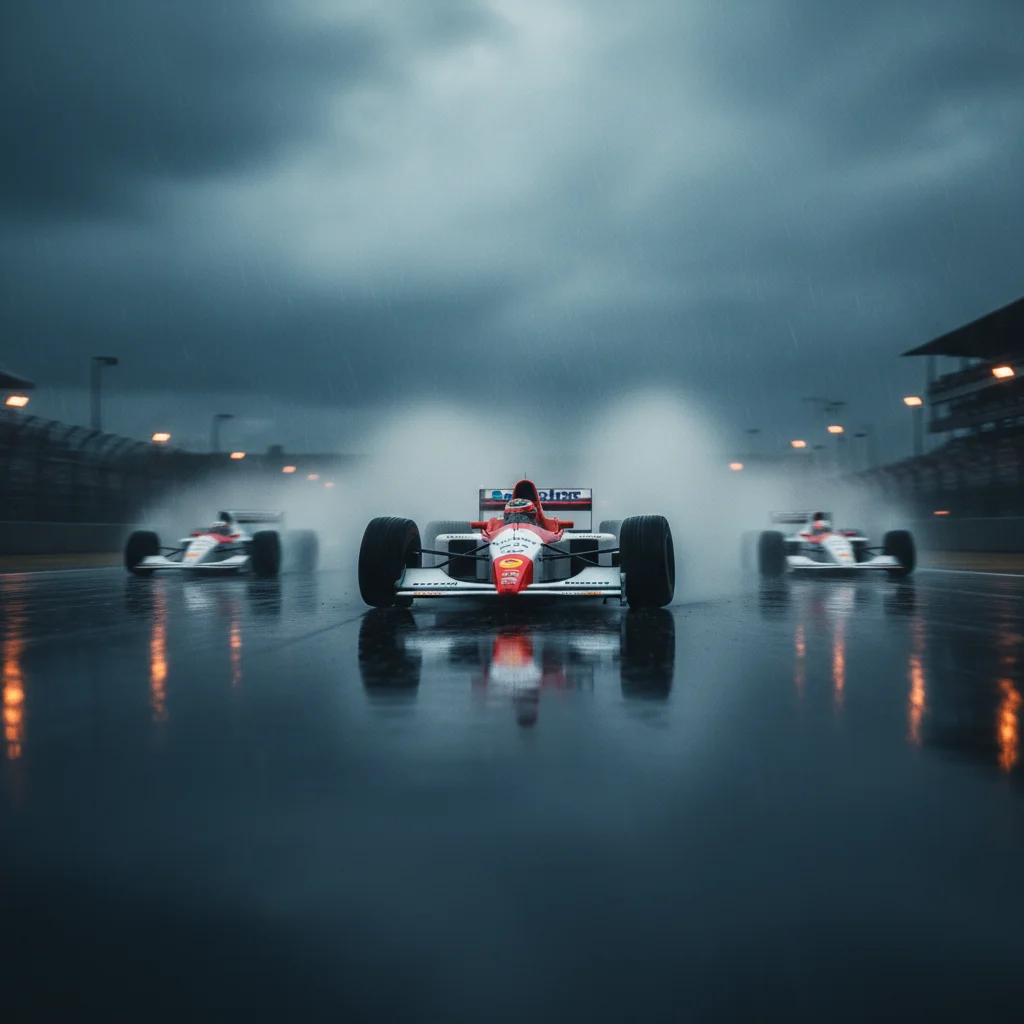
If Senna’s dry-weather pace was extraordinary, his wet-weather driving was something else entirely — something almost supernatural. He earned the nickname “The Rainmaster” not through one or two impressive drives, but through a sustained, career-long ability to make rain-soaked circuits look like his personal playground.
It started at Monaco in 1984. Driving a Toleman — a backmarker team with no business being anywhere near the front — the 24-year-old Senna carved through the field in monsoon conditions, catching and passing car after car until he was closing rapidly on the race leader, Alain Prost. The race was red-flagged before Senna could take the lead, but the damage was done. The world had seen something it couldn’t unsee: a rookie who could drive through rain as though the water simply parted for him.
Then came Estoril in 1985 — his first Grand Prix victory. Senna won by over a minute in torrential rain, lapping the field while other drivers were spinning off. He led every single lap.
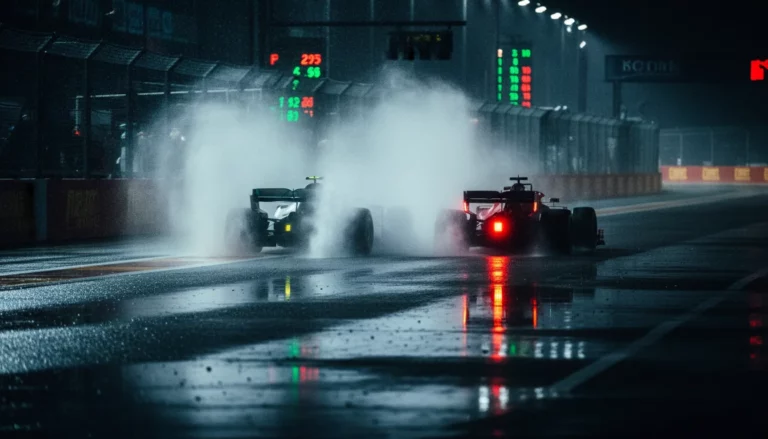
The definitive Senna rain performance came at Donington Park in 1993 during the European Grand Prix. Starting fifth, Senna overtook four cars on the opening lap in conditions so bad that visibility was virtually zero. Michael Schumacher, Damon Hill, Karl Wendlinger, and Prost — all passed before the end of the first lap. He then drove away from the entire field, lapping everyone up to second place. Many consider it the single greatest lap — and greatest race — in F1 history.
What made Senna different in the rain? He practised in it. As a young karter in São Paulo, he would deliberately go out in wet conditions when others stayed in the garage, spending hours learning how a kart behaved on a slippery surface. By the time he reached Formula 1, that childhood obsession had evolved into an almost preternatural feel for grip — an ability to sense the precise moment a tyre was about to lose traction and adjust before it happened.
The Rivalry: Senna vs Prost
No rivalry in the history of motorsport has been as intense, as personal, or as consequential as Senna versus Prost. For four seasons (1988–1993), these two men defined Formula 1 — and their battle forced the sport to confront questions about sportsmanship, ambition, and the limits of acceptable competition that it is still grappling with today.
The rivalry began when Senna joined Prost at McLaren in 1988. The MP4/4, powered by Honda, was the most dominant car F1 had seen — it won 15 of 16 races that season. But the battle within the team was ferocious. Senna took the title by three points, helped by the rule that only a driver’s best 11 results counted. Prost actually scored more total points across the season.
1989 was the flashpoint. Senna attempted to overtake Prost at the chicane in Suzuka. The two collided. Prost walked away; Senna recovered, pitted for a new nose, and crossed the line first — only to be disqualified by the stewards for cutting the chicane when he rejoined. The title went to Prost. Senna was incandescent, believing the establishment had conspired against him.
The following year at Suzuka, Senna took his revenge — and his second World Championship — by deliberately driving into Prost at Turn 1 on the opening lap. Both cars were eliminated, and Senna was champion. It was the most controversial moment in F1 history, and Senna later admitted that rage and the injustice of 1989 had driven his actions.
What makes the rivalry endure is not just the on-track drama but the human story beneath it. Senna and Prost were fundamentally different people — Senna emotional, spiritual, and driven by an almost religious sense of destiny; Prost calculated, precise, and political. They brought out both the best and worst in each other. And in the end, after years of animosity, they reconciled. Just weeks before Senna’s death at Imola in 1994, Prost — who had retired the previous year — visited Senna, and the two spoke warmly. On the morning of the San Marino Grand Prix, witnesses reported that Senna whispered to a friend: “I miss Alain.”
Prost was a pallbearer at Senna’s funeral. He has spoken publicly about the loss every year since. On the 31st anniversary in May 2025, Prost posted a tribute calling Senna a legend and a proper racer. The rivalry that once defined them had long since given way to something deeper.
The Faith: A Spiritual Driver in a Technical Sport
Senna was unlike any other driver in the paddock. In a sport dominated by engineering data, wind tunnels, and telemetry, he spoke openly about God, fate, and the spiritual dimension of racing. He carried a Bible with him to every race, prayed before getting into the car, and attributed his performances to a power greater than himself.
After his qualifying lap at Monaco in 1988, he said: “I was already on pole and I kept going. Suddenly I was nearly two seconds faster than anybody else, including my teammate with the same car. And I realised that I was no longer driving the car consciously. I was driving it by a kind of instinct, only I was in a different dimension.”
This wasn’t performative. Senna genuinely believed he had been chosen for a purpose — that his talent was a gift from God and that his duty was to use it to its fullest extent. That belief gave him an almost reckless courage on the track, a willingness to push beyond limits that other drivers wouldn’t approach. It also made him deeply compassionate off it.
Senna donated millions to children’s charities in Brazil, mostly in secret. Just weeks before his death, he co-founded what would become the Instituto Ayrton Senna, a foundation dedicated to fighting child poverty through education. In the three decades since his passing, the Institute — led by his sister Viviane — has supported over 36 million children across Brazil. It remains one of the most impactful charitable foundations in South American history.
The Championships: Three Titles, Infinite Impact
Senna’s career statistics — 41 wins, 65 poles, 80 podiums, three World Championships — have long since been surpassed numerically by Schumacher, Hamilton, and Max Verstappen. But context matters enormously. Senna competed in an era with far fewer races per season (typically 16 compared to today’s 24), dramatically less reliable cars, and safety standards that would be considered criminally negligent by modern standards.
1988 — Championship 1 (McLaren-Honda): Senna beat Prost in the same car, winning 8 races to Prost’s 7. The MP4/4 won 15 of 16 races — the most dominant single season in F1 history. Senna’s qualifying advantage over his four-time champion teammate was staggering.
1990 — Championship 2 (McLaren-Honda): After the injustice of 1989, Senna took his second title with six victories — including the controversial Suzuka collision with Prost. It was also the year he delivered one of his most celebrated drives, winning from behind in the wet at the Canadian Grand Prix.
1991 — Championship 3 (McLaren-Honda): The year Senna cemented his legend. He won seven races, took his iconic first home victory at the Brazilian Grand Prix in São Paulo — crossing the line with his car stuck in sixth gear, barely able to lift the trophy afterwards due to physical exhaustion — and dominated the season despite the emerging threat of Nigel Mansell’s Williams.
The Brazilian Grand Prix victory in 1991 is one of the most emotional moments in F1 history. Senna’s gearbox had failed progressively throughout the race, leaving him with only sixth gear for the final laps. He drove with one hand while the other clutched a Brazilian flag passed to him on the slowdown lap, tears streaming down his face behind the visor. A nation of 150 million people wept with him.
The Helmet: The Most Iconic Design in Motorsport
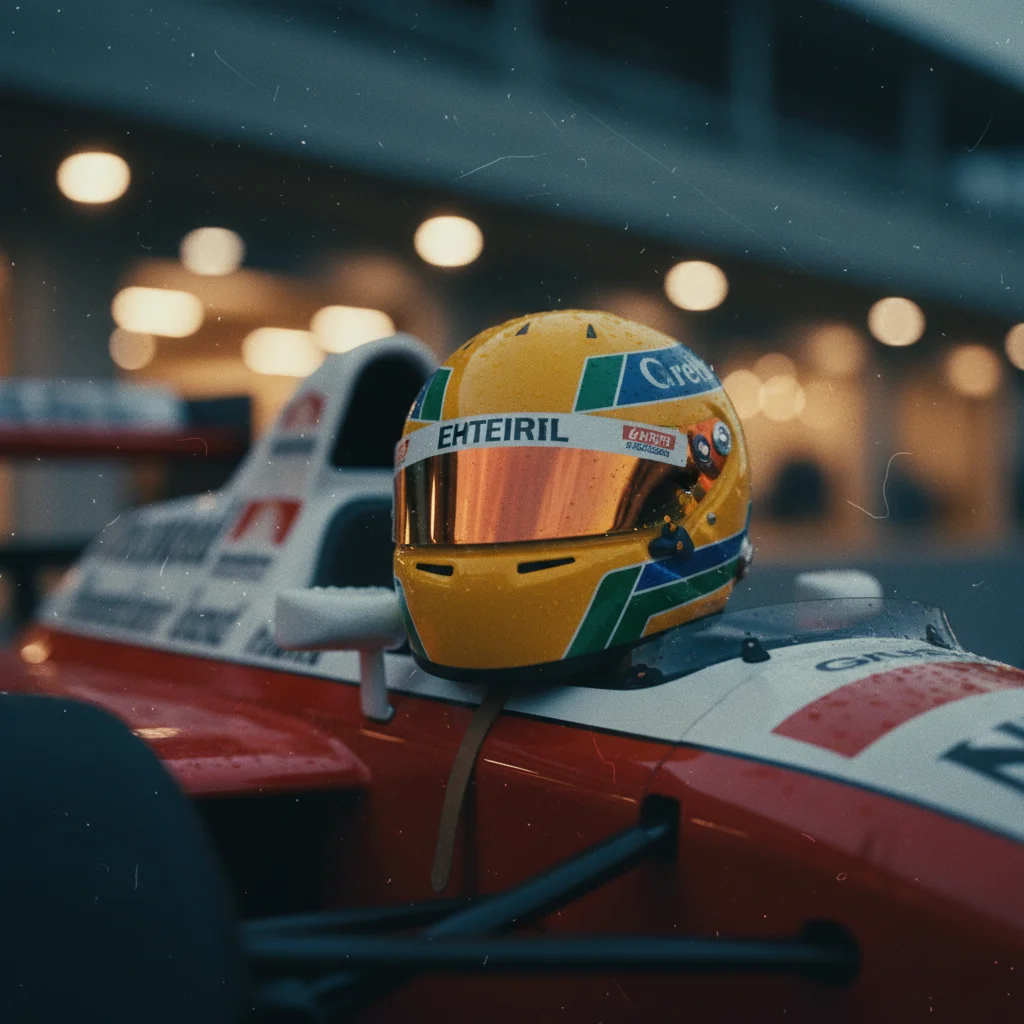
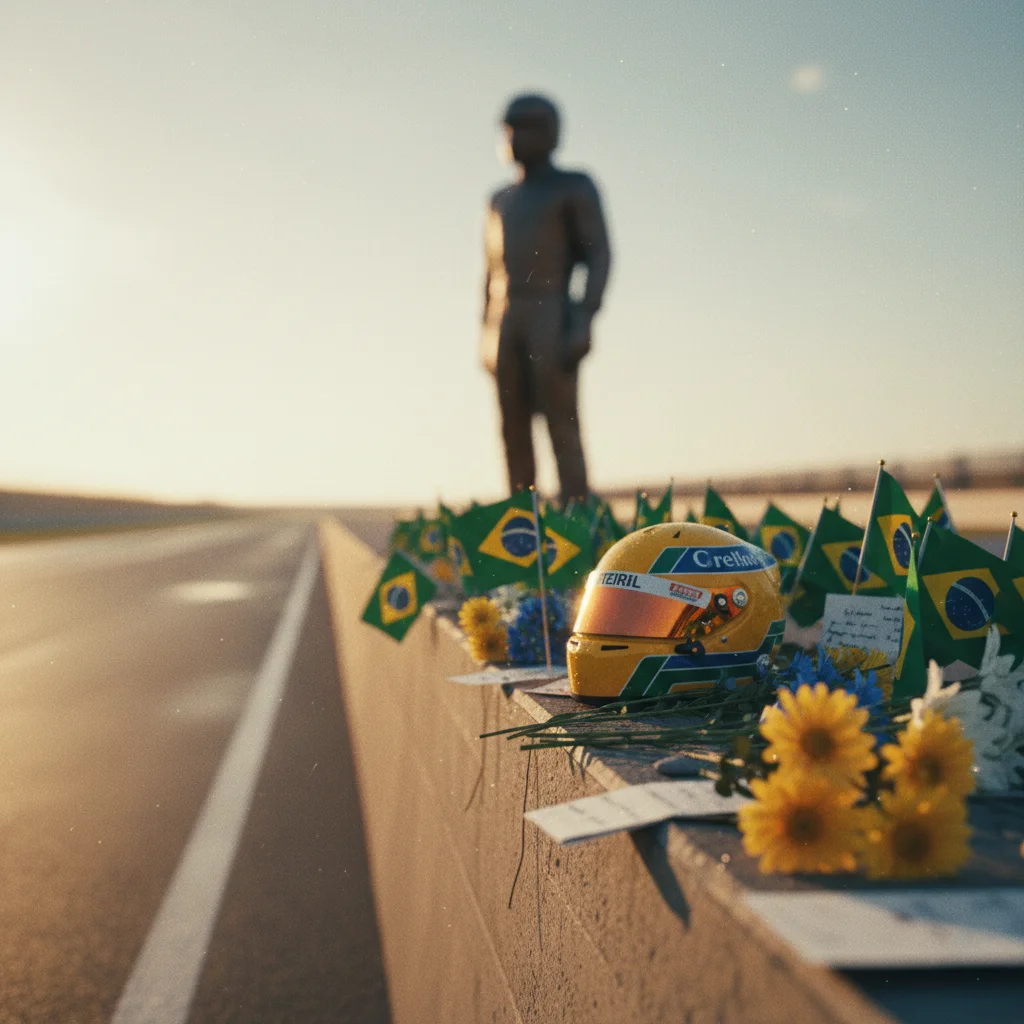
Senna’s helmet — bright yellow with green and blue stripes representing the Brazilian flag — is the most recognisable piece of motorsport design ever created. It has been reproduced on posters, merchandise, murals, and tattoos across every continent. McLaren permanently features a Senna “S” logo on their cars. A Eduardo Kobra mural of Senna’s face adorns the Miami Grand Prix paddock. Statues wearing the helmet stand in São Paulo, Imola, Barcelona, Donington Park, and Estoril.
In 2025, multiple current F1 drivers honoured Senna with special helmet designs at the Monaco Grand Prix. Racing Bulls’ Isack Hadjar wore a helmet featuring Senna’s Monaco statistics, while Sauber’s Gabriel Bortoleto raced in Senna’s colours at his Monaco debut, saying it was an honour to carry the yellow, green, and blue of Brazil’s greatest sporting hero.
The helmet has become shorthand for greatness itself. When Hamilton equalled Senna’s record of 65 pole positions at the 2017 Canadian Grand Prix, the Senna family presented him with one of Ayrton’s original helmets — a gesture that moved Hamilton to tears. He later called it the greatest honour of his career.
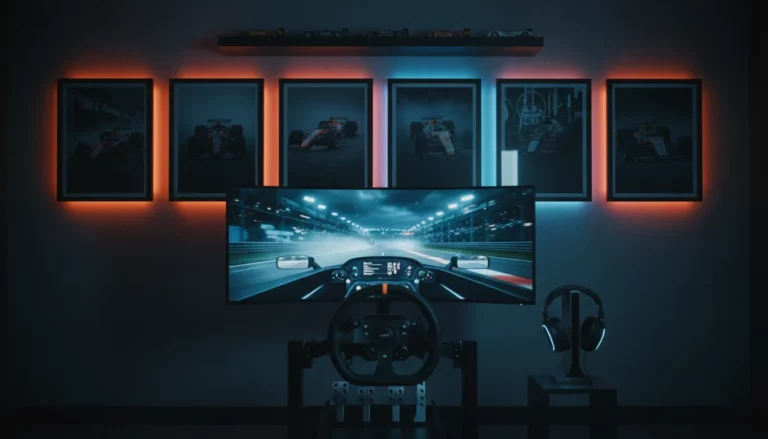
For poster collectors and F1 fans, Senna’s helmet is arguably the most popular single image in all of motorsport. Its bold colours, clean design, and emotional associations make it the kind of artwork that stops people in their tracks — whether on a gallery wall or above a desk.
Imola, 1 May 1994: The Day Formula 1 Lost Its Soul
The 1994 San Marino Grand Prix weekend at Imola was the darkest in F1 history. On the Saturday, Austrian rookie Roland Ratzenberger was killed during qualifying after a front wing failure sent his car into a concrete wall at over 300km/h. Senna, who had gone to the scene of the crash and was visibly shaken, considered withdrawing from the race but ultimately decided to compete.
On lap 7 of the Grand Prix, leading the race, Senna’s Williams FW16 left the track at the high-speed Tamburello corner and struck the concrete barrier. The impact was catastrophic. Senna was airlifted to hospital but pronounced dead that afternoon. He was 34 years old.
The cause of the crash remains debated to this day. The official investigation concluded that the steering column had broken — a modification made after Senna complained about the car’s handling. Williams were initially convicted of manslaughter under Italian law, though the verdict was later overturned on appeal.
Senna’s state funeral in São Paulo was attended by an estimated three million people lining the streets. The Brazilian government declared three days of national mourning. His coffin was carried by, among others, Alain Prost, Emerson Fittipaldi, and Gerhard Berger. The outpouring of grief was unlike anything the sporting world had seen.
His death transformed Formula 1. The FIA implemented sweeping safety reforms — redesigned barriers, stricter crash testing, the HANS device, improved circuit design — that have saved countless lives since. The halo device, introduced in 2018, can trace its philosophical lineage directly back to the lessons learned at Imola. Senna was the last driver killed during a Formula 1 World Championship race weekend until Jules Bianchi’s accident in 2014.
| Era | Team | Seasons | Races | Wins | Poles | Podiums | Titles | Defining Moment |
|---|---|---|---|---|---|---|---|---|
| 1984 | Toleman | 1 | 14 | 0 | 0 | 3 | — | Monaco ’84 — caught race leader in monsoon conditions driving a backmarker car |
| 1985–87 | Lotus | 3 | 48 | 6 | 16 | 17 | — | First win at Estoril ’85 in the rain — led every lap, won by over a minute |
| 1988–93 | McLaren | 6 | 96 | 35 | 46 | 55 | 🏆🏆🏆 | 3 titles. 15/16 wins in ’88. Donington ’93 opening lap. Brazil ’91 in 6th gear |
| 1994 | Williams | 1 | 3 | 0 | 3 | 0 | — | Took pole at all 3 races. Killed at Imola, 1 May 1994, while leading the race |
| CAREER | 1984–94 | 10 | 161 | 41 | 65 | 80 | 3 | Toleman → Lotus → McLaren → Williams |
The Legacy: Why He’s Still the Greatest
Thirty-one years later, Senna’s name carries more emotional weight than any driver who has come before or since. Hamilton has more wins. Schumacher equalled and then shared his record for championships. Verstappen has shattered the single-season wins record. And yet, when Formula 1 itself asks current drivers and team principals who the greatest of all time is, Senna’s name comes up more often than any other.
Why?
Because Senna didn’t just drive fast — he drove with a ferocity, a passion, and a spiritual intensity that no one else has ever matched. He made you feel something when you watched him race. He elevated the sport from a technical exercise into something emotional, dramatic, and deeply human. He was flawed — the Suzuka incidents, the political manoeuvring, the occasional ruthlessness — but those flaws only made his brilliance burn brighter by contrast.
Because he died before his story was finished. He was 34 — in what should have been his prime — driving for Williams, the team that had dominated the sport the year before. A fourth title, perhaps a fifth, seemed inevitable. Instead, his final chapter was written in concrete and silence, and the world was left to wonder what might have been.
Because his legacy extends far beyond racing. The Instituto Ayrton Senna has transformed the lives of over 36 million children. His name is synonymous with Brazil itself — not just its sporting ambition but its national identity, its hope, and its resilience. He was inducted into the Automotive Hall of Fame in 2025, further cementing his place in history.
And because, at a fundamental level, people who love Formula 1 understand that Senna represented something that can’t be measured by data or statistics: the pure, unfiltered will to be the best. Not the most efficient, not the most calculated, not the most politically savvy — the best. At any cost. In any conditions. Against any opponent.
Still I Rise — the motto that Lewis Hamilton would later make his own — could just as easily have been written by Ayrton Senna. Because no driver in history rose higher, burned brighter, or left a deeper mark on the sport he loved.
Celebrate Senna’s Legacy on Your Wall
Ayrton Senna’s yellow helmet, the red and white of McLaren, the spray of rain, the raised fist — these are images that belong on walls, not just in memory. Whether you watched him race live or discovered him through documentaries, Netflix, or the stories passed down by older fans, Senna’s visual legacy is one of the most powerful in all of sport.
At Poster Print Base, our Ayrton Senna poster captures the Brazilian legend in stunning detail — the helmet, the car, the man. It’s the perfect centrepiece for any F1 fan’s collection, and pairs beautifully with prints of the drivers he inspired and the rivals who pushed him: Lewis Hamilton, Niki Lauda, Max Verstappen, Sebastian Vettel, Nigel Mansell, Sir Jackie Stewart, and Gilles Villeneuve.
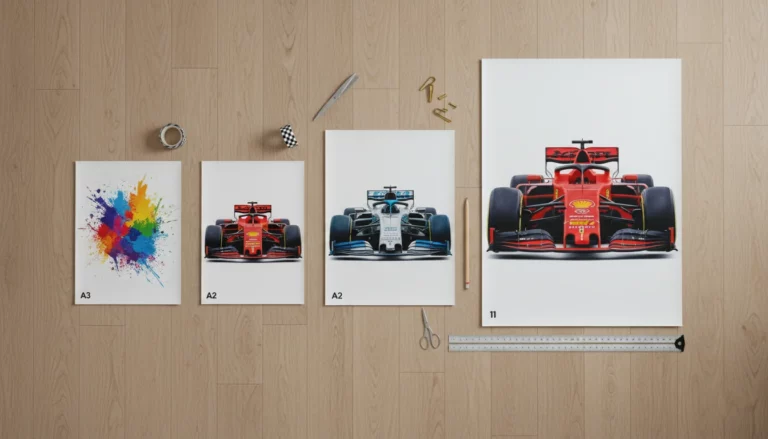
Every poster is printed on premium 250gsm glossy, fade-resistant photo paper with high-resolution digital printing, available in A3, A2, and A1 sizes with free UK delivery.
Shop the Ayrton Senna Poster →
Browse the full Formula 1 poster collection →
Love motorsport? Explore our full range of sports posters or discover more F1 prints, vintage F1 art, and racing wall art at Poster Print Base.