Behind the Helmet: The Best F1 Helmet Designs of All Time
A driver’s helmet is the most personal object in Formula 1. It’s their signature, their shield, and their identity at 300km/h. Here are the designs that became as legendary as the drivers who wore them.
In a sport where cars change every season and team liveries shift with sponsor deals, one thing belongs entirely to the driver: their helmet. It’s the only piece of equipment that follows them from team to team, from karting to Formula 1, from their first race to their last.
A great helmet design doesn’t just look good. It tells a story — of nationality, personality, family, and ambition. When you see a flash of yellow in your mirrors, you know it’s Senna. A streak of neon squiggles means Norris is coming. A red arrow on white means Mansell is about to make your afternoon very difficult.
Here are the helmet designs that transcended safety equipment and became icons of the sport.
1. Ayrton Senna — Yellow, Green, and Blue
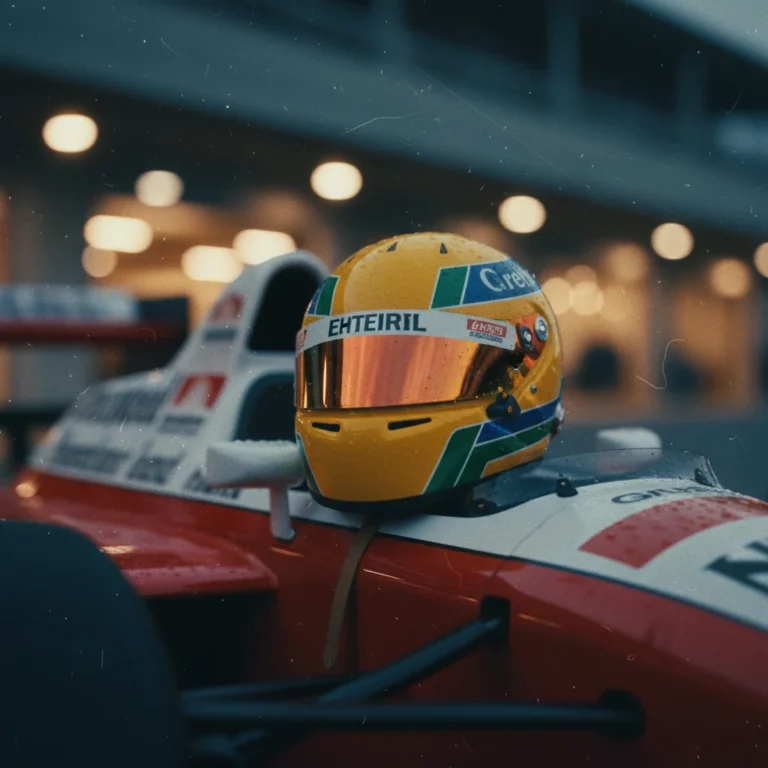
No helmet in motorsport history is more recognisable. Ayrton Senna‘s vivid yellow lid, slashed with the green and blue of the Brazilian flag, is the single most iconic design in F1 — and arguably in all of sport.
The design was created by Sid Mosca, a São Paulo-based helmet painter, in 1979. A teenage Senna had been selected to represent Brazil at the World Karting Championship in Estoril, and regulations required all Brazilian team members to wear matching helmets in the national colours. Mosca had just five days to paint them. The result — bold yellow with sweeping green and blue bands — was so striking that Senna kept it for the rest of his career.
What makes the design endure isn’t just its visual punch. It’s inseparable from the moments it witnessed: pole position at Monaco by 1.4 seconds in 1988, the Donington masterclass in 1993, and the tragedy at Imola in 1994. When drivers see that yellow flash in their mirrors, even now, they know exactly what it represents. Hamilton, Vettel, Norris, and Piastri have all worn Senna-tribute helmets over the years. McLaren painted their entire car in Senna’s colours for the 2024 Monaco Grand Prix.
One of Senna’s original helmets reportedly fetched close to $1 million at auction. No other piece of F1 memorabilia carries the same emotional weight.
2. Michael Schumacher — Red, Black, and Gold
Michael Schumacher’s helmet evolved throughout his career, but the version most people picture is the Ferrari-era design: a bright red base with black and gold accents, the German flag running across the top. It was the helmet of domination — five consecutive championships between 2000 and 2004, 91 career wins, and a relentlessness that redefined what was possible in Formula 1.
Before Ferrari, Schumacher wore a predominantly blue and white design at Benetton. But when he moved to Maranello in 1996, he made a deliberate decision to match his helmet to the team — replacing the German flag stripes with Ferrari red. It was the first time a top driver had fundamentally redesigned their helmet to align with their team’s identity, and it started a trend that continues to this day.
The design was painted by Jens Munser, a German artist who has become the most sought-after helmet painter in motorsport. Munser worked with Schumacher for years, and the pair refined the design together — always prioritising weight saving, sometimes even at the expense of a glossy finish.
3. Lewis Hamilton — The Ever-Evolving Canvas
No driver in F1 history has used their helmet as a tool for self-expression quite like Lewis Hamilton. Over 19 seasons and counting, Hamilton has run dozens of designs — from his original Senna-tribute yellow at McLaren to the striking purple and black “Black Lives Matter” helmet of 2020, from artist collaborations with Takashi Murakami and Hajime Sorayama to the all-yellow throwback he debuted at Ferrari in 2025.
Hamilton’s early career helmet was a direct homage to Senna — yellow base with red and green accents. He wore a variation of it when he won his first championship in dramatic fashion at the 2008 Brazilian Grand Prix, the same circuit where Senna had raced as a hero. The emotional connection was obvious and powerful.
As his career progressed, Hamilton began treating each Grand Prix as an opportunity for a new design. His 2023 Japanese GP helmet, a collaboration with chrome-art specialist Hajime Sorayama, became one of the most talked-about designs of the modern era. His 2019 Monaco tribute to the late Niki Lauda — an all-red lid with an “L” on the visor — was worn when he took pole and the win in an emotional weekend.
When the FIA lifted its one-design-per-season rule in 2020, Hamilton was the driver who seized the opportunity most aggressively. His helmet became a storytelling device — each race a new chapter, each design a statement about identity, heritage, or social causes.
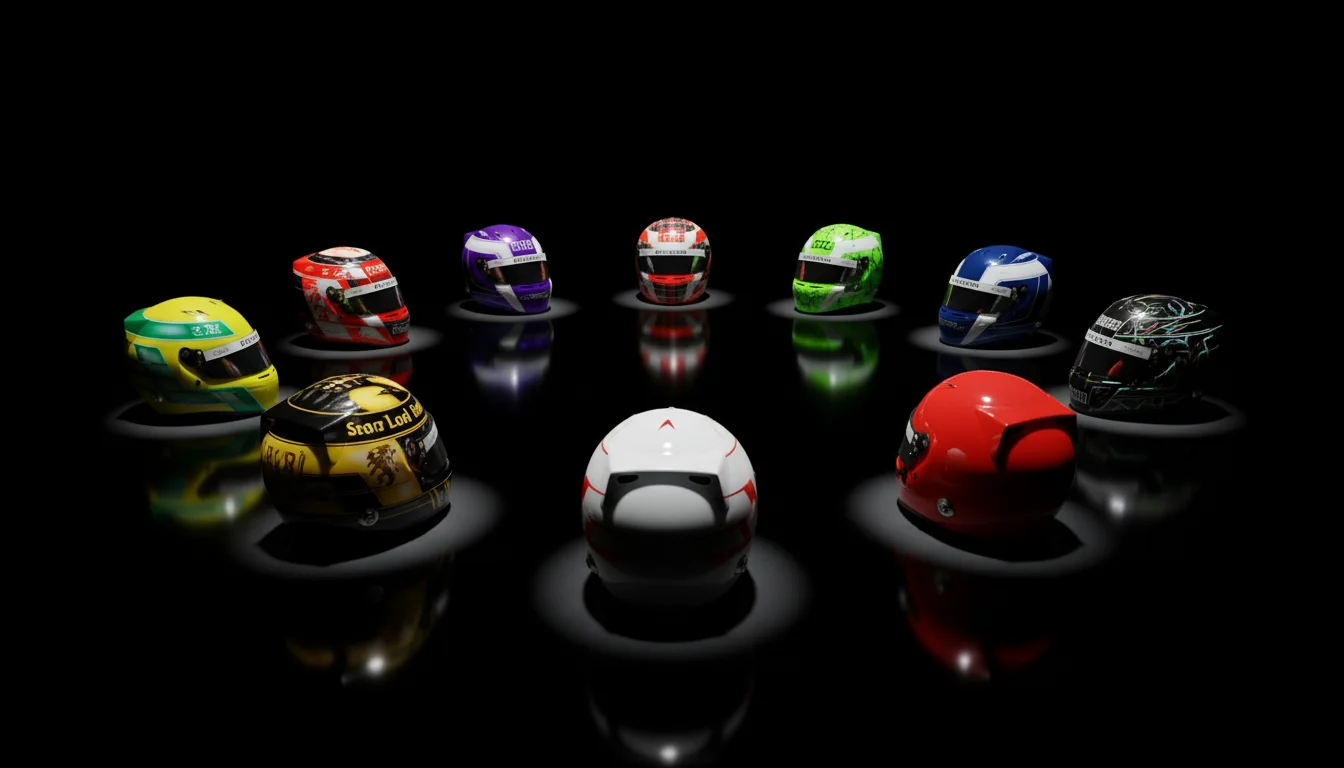
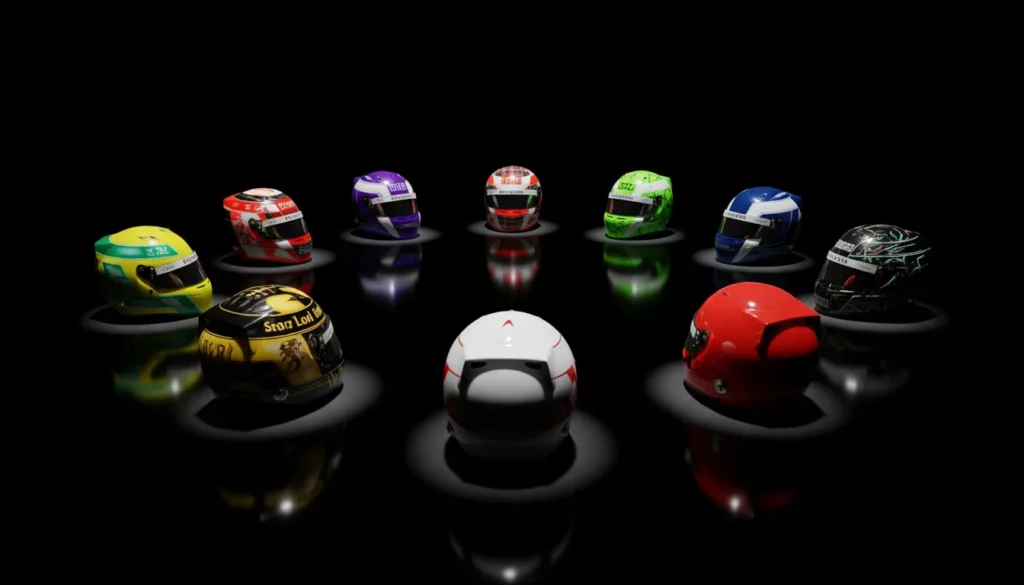
🪖 The 10 Most Iconic F1 Helmet Designs
The stories, colours, and symbols behind the sport’s most legendary lids
| # | Driver | Colours | Design Name | Origin Story | Type |
|---|---|---|---|---|---|
| 1 | Ayrton Senna1979 – 1994 | Brazilian Flag Bands | Painted by Sid Mosca in 5 days for the 1979 World Karting Championship. National team rules required Brazilian colours — Senna never changed it. | National | |
| 2 | Michael Schumacher1996 – 2006 | Ferrari Red & Gold | Switched from German flag blue to Ferrari red in 1996 — first driver to redesign for his team. Painted by Jens Munser, prioritising weight over gloss. | Team | |
| 3 | Lewis Hamilton2007 – present | The Evolving Canvas | Started as a Senna tribute yellow at McLaren. Evolved through dozens of one-offs — BLM purple/black (2020), Sorayama chrome (2023), Lauda red tribute (2019), Ferrari yellow return (2025). | Personal | |
| 4 | Jackie Stewart1965 – 1973 | Royal Stewart Tartan | Clan tartan band on white base — the red hid bloodstains in battle, per Stewart family history. Predates the full-face helmet era. | Heritage | |
| 5 | Max Verstappen2015 – present | The Dutch Lion | Dutch tricolour base with snarling lion motif. Painted by Mad 56 (Massimo Dante). The lion symbolises the Netherlands and Verstappen’s aggression on track. | National | |
| 6 | Nigel Mansell1980 – 1995 | The Red Arrow | Red arrow slicing through white with Union Jack blue accents — as combative as the man who wore it. Iconic through his dominant 1992 Williams season. | Personal | |
| 7 | Niki Lauda1971 – 1985 | The Simple Red | Plain red with Austrian flag stripe — functional, no-nonsense. After his 1976 Nürburgring fire, the unchanged design became a symbol of survival and courage. | National | |
| 8 | Graham & Damon Hill1958 – 1999 | The Rowing Club Oars | Eight white oars on midnight blue — inspired by London Rowing Club where Graham met his wife. Damon wore the same design, winning his own title in 1996. | Heritage | |
| 9 | Lando Norris2019 – present | Neon Squiggles | Abstract neon patterns and “LN” logo by Jens Munser. Reflects the social media generation — vivid, energetic, instantly recognisable in McLaren papaya. | Modern | |
| 10 | James Hunt1973 – 1979 | The School Colours | Black base with red, blue, and yellow stripes from Wellington College, Berkshire. Oversized “HUNT” lettering — as rebellious as the man himself. | Heritage |
4. Jackie Stewart — The Royal Stewart Tartan
Sir Jackie Stewart‘s white helmet with its band of Royal Stewart tartan is one of the most elegant designs in F1 history — and one of the few that predates the full-face helmet era.
The three-time world champion chose the tartan of his family clan, wrapping it around a clean white base. In an era before sponsor logos cluttered every surface, the simplicity was its strength. You could spot Stewart from any grandstand, at any distance. The predominantly red tartan served an additional purpose that Stewart himself has referenced — historically, the Stewart clan chose red tartan so that bloodstains from battle wouldn’t be visible to enemies. A fitting detail for a man who risked his life every time he raced on circuits that were, by modern standards, astonishingly dangerous.
Stewart’s tartan became so associated with his identity that it outlasted his racing career entirely. To this day, the Stewart tartan is synonymous with Scottish motorsport excellence.
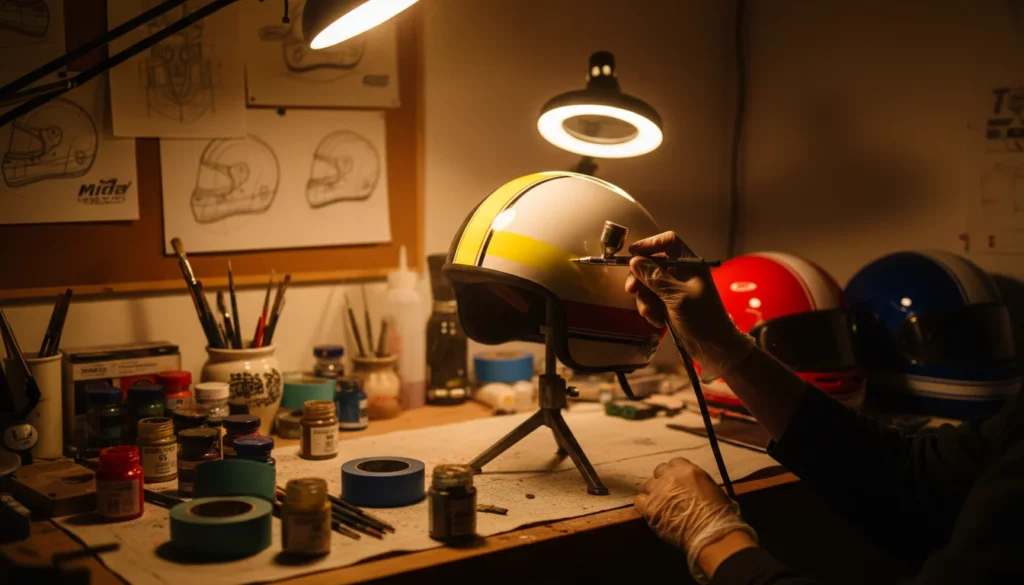
5. Max Verstappen — The Lion
Max Verstappen‘s helmet is the most recognisable design of the current generation. The base is built around the Dutch national colours — red, white, and blue — but the defining feature is the lion: a snarling beast that wraps around the side and back, a symbol of both the Netherlands and Verstappen’s own racing temperament.
The design is painted by Mad 56 (Massimo Dante), an Italian artist who has worked with Red Bull drivers for over a decade. The lion motif has become Verstappen’s personal brand — as recognisable as Senna’s yellow or Schumacher’s red. Fans wear orange lion merchandise at every Dutch Grand Prix, and the helmet design has been reproduced on everything from caps to phone cases.
What makes the design effective is its aggression. Where Senna’s helmet warned of brilliance, Verstappen’s warns of confrontation. The lion doesn’t politely ask for the racing line — it takes it.
6. Nigel Mansell — The Red Arrow
Nigel Mansell‘s helmet was as combative as the man who wore it. A red arrow slicing through a white base, with blue accents echoing the Union Jack — it was the design of a driver who never, ever gave an inch.
Mansell’s 1992 championship-winning season with Williams produced some of the most dominant performances in F1 history, and through all of it, that red arrow was the visual shorthand for British bulldog determination. The design was simple enough that it worked equally well on the open-face helmets of the early 1980s and the full-face designs of the 1990s.
7. Niki Lauda — The Simple Red
Niki Lauda‘s helmet tells a story of survival more than design. The three-time champion’s original lid was a straightforward red with the Austrian flag — clean, no-nonsense, exactly like the man himself.
But after his horrific crash at the Nürburgring in 1976, when he suffered severe burns to his face and scalp, the helmet took on a different significance. When Lauda returned to racing just six weeks later at Monza, blood seeping from his wounds into the helmet padding, the simple red lid became a symbol of almost superhuman courage. He never felt the need to change it. The design remained virtually the same from his first championship in 1975 to his last in 1984 — because for Lauda, the helmet was never about aesthetics. It was about function. Just like everything else he did.
8. Graham and Damon Hill — The Rowing Club Oars
One of F1’s most touching design stories spans two generations. Graham Hill’s midnight blue helmet, adorned with eight white stripes representing rowing oars, was inspired by the London Rowing Club where he met his wife, Bette. The design accompanied him to two world championships in 1962 and 1968.
When his son Damon entered Formula 1 decades later, he wore the same design — an act of tribute to a father killed in a plane crash in 1975. Damon’s 1996 world championship victory at Suzuka, wearing his father’s colours, was one of the most emotionally charged moments in F1 history. One family, one design, three titles. No other helmet carries that kind of generational weight.
9. Lando Norris — The Neon Squiggles
Lando Norris‘s helmet is the most distinctly “modern” design on this list — and deliberately so. The neon colour palette, abstract squiggle patterns, and prominent “LN” logo reflect a driver who grew up in the streaming and social media age and understands personal branding instinctively.
The design, painted by Jens Munser (the same artist who created Schumacher’s Ferrari-era helmets), changes subtly from season to season but retains the same DNA: vivid, energetic, unmistakably Norris. In the McLaren papaya car, the neon helmet creates a visual identity that no other driver on the grid can match.
As the reigning world champion, Norris’s helmet is now carried by the most successful McLaren driver since Hamilton — and the design is well on its way to becoming one of the defining looks of its era.
10. James Hunt — The School Colours
James Hunt’s helmet was pure Hunt: irreverent, charming, and carrying a backstory that only he could pull off. The black base featured three stripes — red, blue, and yellow — which were the colours of his school, Wellington College in Berkshire.
In an era of increasing sponsor influence, Hunt’s insistence on wearing his old school colours was a quiet act of rebellion and nostalgia. Combined with the oversized “HUNT” lettering on the side, it created one of the most recognisable helmets of the 1970s — and the perfect visual complement to one of F1’s most colourful personalities.
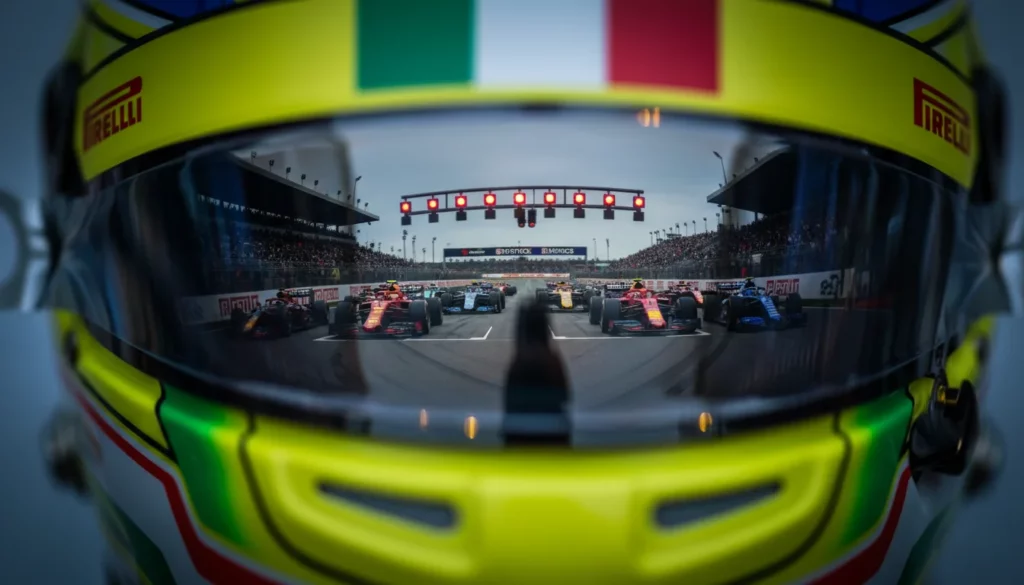
Why Helmets Matter to Fans
Helmet designs occupy a unique space in fan culture. They’re more personal than a car livery (which belongs to the team) and more permanent than a race number (which can change). A helmet belongs to the driver — it’s the one visual element that says “this is me” regardless of which team they drive for.
For poster collectors and fan room builders, helmet designs offer something special. A poster featuring a driver’s helmet tells the story of who they are, not just which team employs them. Hamilton’s yellow lid connects him to Senna across three decades. Verstappen’s lion connects him to an entire nation’s sporting identity. The Hills’ rowing oars connect a son to his father across the gulf of tragedy.
When you hang an F1 poster that features a helmet design, you’re not just decorating a wall — you’re displaying the most personal symbol in motorsport.
Browse the full Formula 1 poster collection at Poster Print Base — featuring iconic F1 driver posters from Senna to Verstappen, Hamilton to Norris. Printed on premium 250gsm paper, available in A3, A2, and A1 sizes, with free UK delivery on every order.
Explore more F1 content: The 10 Most Iconic F1 Liveries of All Time | F1 Team Colours: The Stories Behind the Iconic Looks | The Greatest F1 Rivalries in History | How to Create the Ultimate F1 Fan Room