The Greatest F1 Rivalries in History
From Senna vs Prost to Hamilton vs Rosberg, Norris vs Piastri to Verstappen’s war with the world — these are the battles that defined Formula 1.
Formula 1 has always been about more than speed. Strip away the technology, the strategy, the aerodynamics, and what you’re left with is the oldest story in sport: two people who want to win, and only one trophy between them.
The greatest F1 rivalries transcend the track. They expose egos, test friendships, divide families, and reshape the political landscape of entire teams. They turn teammates into enemies and opponents into obsessions. And they create the moments that fans remember decades after the final chequered flag.
Here are the rivalries that defined Formula 1.
Senna vs Prost (1988–1993) — The Defining Rivalry
No sporting rivalry in any discipline has been more analysed, more dramatised, or more emotionally devastating than Ayrton Senna versus Alain Prost. It is the benchmark against which every F1 feud is measured, and nothing has surpassed it.
The rivalry began in 1988 when Senna joined Prost at McLaren. On paper, they were the perfect pairing — Prost, the calculating Frenchman nicknamed “The Professor,” already a double world champion, paired with Senna, the Brazilian prodigy with unmatched speed and an almost spiritual intensity behind the wheel. Together, they won 15 of 16 races that season in the dominant McLaren-Honda MP4/4.
But equality bred contempt. Both men wanted to be the undisputed number one. Their contrasting personalities — Prost’s political intelligence versus Senna’s raw emotional force — created a friction that the team couldn’t contain. When Senna won the 1988 championship by just three points after a controversial disqualification and reinstatement at Monza, the fault lines were already visible.
In 1989, the rivalry turned toxic. At the penultimate round in Suzuka, Prost turned into Senna at the chicane, taking both cars off the track. Prost’s title was secured; Senna was left furious, convinced the collision was deliberate. A year later, at the same corner, Senna took his revenge — deliberately driving into Prost at the start, sending both cars into the gravel. Senna won the championship. He later admitted he’d done it on purpose.
What elevates this rivalry beyond sport is its ending. Prost retired after winning the 1993 title with Williams. Senna, who had replaced him at the team for 1994, was killed at Imola on the first day of May that year. The rivalry was frozen in time, unresolved, immortal. Prost was a pallbearer at Senna’s funeral.
Three championships apiece. 15 wins in a single season as teammates. Two deliberate collisions. One death. No rivalry in F1 — or perhaps any sport — cuts deeper.
Hunt vs Lauda (1976) — Fire and Ice
If Senna vs Prost was a cold war, Hunt vs Lauda was a Hollywood film — literally. Ron Howard’s 2013 movie Rush brought this rivalry to a global audience, but the real story is even more extraordinary than the dramatisation.
James Hunt was the playboy — handsome, reckless, hard-drinking, utterly fearless. Niki Lauda was his opposite — methodical, disciplined, calculating, with a face that looked like it belonged in an accountant’s office rather than a racing cockpit.
Lauda dominated the first half of the 1976 season, winning five of the first nine races for Ferrari. Then came the Nürburgring. On the first of August, Lauda’s car caught fire after a crash on the old Nordschleife. He was trapped in the inferno, inhaling toxic fumes and suffering horrific burns to his face and lungs. He received the last rites in hospital.
Six weeks later — six weeks — Lauda climbed back into his Ferrari at Monza. His face was still bandaged. His eyelids couldn’t close properly. Blood seeped from his wounds into his helmet. He finished fourth.
The championship came down to the final race at a rain-soaked Fuji Speedway in Japan. Lauda, unable to see properly through the spray, pulled into the pits after two laps and withdrew. Hunt drove through the storm to finish third — enough to win the championship by a single point.
What makes this rivalry endure isn’t the competitiveness — it’s the humanity. Hunt and Lauda, despite their opposite personalities, became genuine friends in later life. Lauda went on to win two more championships; Hunt retired at 31 and died of a heart attack at 45. Their rivalry was a story about courage, mortality, and what it costs to push yourself to the very edge.
⚔️ The Greatest F1 Rivalries
Eight battles that defined Formula 1 — ranked by drama, stakes, and legacy
| Rivalry | Era | Defining Moment | Intensity | Legacy |
|---|---|---|---|---|
Senna VS Prost |
1988–93 | Suzuka 1989 & 1990 — Two deliberate collisions. Two championships decided by contact. | Collision | |
Hunt VS Lauda |
1976 | Nürburgring fire & Fuji rain — Lauda nearly died, returned in 6 weeks. Lost title by 1 point. | Heartbreak | |
Hamilton VS Rosberg |
2014–16 | Abu Dhabi 2016 — Hamilton slowed deliberately. Rosberg held nerve. Retired 5 days later. | Retirement | |
Hamilton VS Verstappen |
2021 | Abu Dhabi 2021 — Level on points. Controversial last-lap safety car restart. Title decided on final corner. | Controversy | |
Norris VS Piastri |
2025 | Three-way Abu Dhabi decider — Norris won title by 2 points. Piastri led standings for 15 races. | Ongoing | |
Schumacher VS Hill |
1994 | Adelaide 1994 — Schumacher hit wall, turned into Hill. Both retired. Title decided by contact. | Collision | |
Schumacher VS Häkkinen |
1998–00 | Spa 2000 — Häkkinen overtook around a lapped car at 300km/h. Greatest overtake ever. | Mutual respect | |
Piquet VS Mansell |
1986–87 | Williams civil war — Piquet insulted Mansell publicly. Infighting cost both the 1986 title. | Self-destructive |
Hamilton vs Rosberg (2014–2016) — The Friendship That Died
Lewis Hamilton and Nico Rosberg had been friends since they were teenagers racing karts together. By the time their rivalry ended, they could barely look at each other.
Mercedes’ dominance from 2014 onwards meant the championship was essentially a two-horse race between their drivers. Hamilton won the first two titles in 2014 and 2015, but Rosberg pushed him every step of the way — and the pressure cracked the friendship wide open.
The defining moments came in rapid succession. In Monaco 2014, Rosberg allegedly set a deliberately slow sector in qualifying to bring out yellow flags and secure pole. In Spa 2014, Rosberg hit Hamilton on the opening lap, puncturing his tyre. In Austin 2015, Hamilton celebrated his third title by throwing his cap at Rosberg on the podium; Rosberg threw it back. Behind the silver bodywork, a war was raging.
In 2016, Rosberg came out swinging. He won the first four races of the season. Hamilton fought back through the summer, but Rosberg’s consistency was relentless. The championship went to the final race in Abu Dhabi. Hamilton led, with Rosberg behind him, needing only a podium. Hamilton deliberately slowed down in the closing laps, backing Rosberg into the cars behind, trying to create chaos. The team ordered him to speed up. He ignored them.
Rosberg held his nerve, finished second, and won the championship by five points. Five days later, he retired from the sport entirely — walking away as world champion, never to race again. It was one of the most shocking retirements in sporting history.
Hamilton and Rosberg’s relationship has never fully recovered. What began as a childhood friendship ended as one of F1’s most bitter internal wars — proof that sharing a garage is more dangerous than sharing a track.
Prost vs Mansell (1990–1993) — The Team Destroyer
While Senna vs Prost dominates the conversation, Prost’s rivalry with Nigel Mansell was equally venomous — and arguably more politically destructive.
When Mansell joined Prost at Ferrari in 1990, the Frenchman was already the established number one. Mansell, never one to accept a secondary role, pushed back immediately. The two clashed on and off track, with Mansell famously accusing Prost of politicking within the team to gain preferential treatment.
Mansell left Ferrari after a single season, returning to Williams where he finally won the 1992 championship in dominant fashion. But when Prost arrived at Williams for 1993, Mansell refused to stay. He walked away from F1 entirely rather than partner the man he despised, heading to IndyCar where he won the title at his first attempt.
Prost, meanwhile, won the 1993 championship with Williams — his fourth — and retired. The irony is that both men achieved their greatest successes apart, poisoned by a rivalry that left two of the most talented teams of the era unable to field them together.
Hamilton vs Verstappen (2021) — The Most Controversial Finale
The 2021 championship between Lewis Hamilton and Max Verstappen was the most intense single-season battle F1 has witnessed since Senna vs Prost.
From the opening race in Bahrain, where Verstappen overtook Hamilton off-track and was ordered to give the position back, to the season finale in Abu Dhabi, the championship was a war of attrition. They collided at Silverstone, sending Verstappen into the barriers at 180mph. They collided again at Monza, with Verstappen’s Red Bull landing on top of Hamilton’s Mercedes. They jousted in Saudi Arabia, with both men receiving penalties and accusations of brake-testing flying in both directions.
Going into the final race in Abu Dhabi, they were level on points — 369.5 each. Hamilton dominated the race, leading comfortably with five laps to go. Then Nicholas Latifi crashed, bringing out the safety car. What followed became the most controversial moment in F1 history: race director Michael Masi allowed only the lapped cars between Hamilton and Verstappen to unlap themselves, then restarted the race for a single lap.
Verstappen, on fresh soft tyres, overtook Hamilton on the final lap to win the championship. Mercedes protested. The FIA upheld the result but later acknowledged that Masi’s application of the rules was incorrect. Masi was subsequently removed from his role.
The rivalry defined a generation. Hamilton, who many believe was robbed, remained gracious in the aftermath. Verstappen went on to dominate 2022, 2023, and 2024. But Abu Dhabi 2021 remains the most debated moment in the sport’s 75-year history.
Norris vs Piastri vs Verstappen (2025) — The Three-Way War
The 2025 season produced something F1 hadn’t seen since 2010: a genuine three-way title fight going into the final race. And it was McLaren’s internal battle that provided the most compelling drama.
Lando Norris and Oscar Piastri had coexisted peacefully during McLaren’s 2024 constructors’ title campaign, but 2025 was different. Both cars were fast enough to win the championship — and both drivers knew it.
Piastri took the early initiative, leading the championship from Saudi Arabia in April through to Mexico in October. He won in Shanghai, Bahrain, Saudi Arabia, Spain, Spa, and more. Norris started brilliantly with victory in Australia but then endured a six-race winless streak while Piastri built a 34-point advantage.
The tension between the teammates became the paddock’s dominant storyline. McLaren’s “Papaya Rules” — their policy of allowing their drivers to race freely — was tested to breaking point. In Canada, Norris ran into the back of Piastri during a late-race battle, retiring on the spot. In Monza, McLaren asked Piastri to give a position back to Norris after a pit stop sequence went wrong, echoing a similar controversy at the 2024 Hungarian Grand Prix. Piastri complied, but reluctantly.
Meanwhile, Verstappen and Red Bull were staging a comeback for the ages. From 104 points behind Piastri in the summer, Verstappen clawed his way back into contention with an extraordinary run of nine consecutive podiums from August onwards, including victories at key circuits. McLaren’s disqualification in Las Vegas and a strategic disaster in Qatar brought Verstappen within 12 points of Norris heading into Abu Dhabi.
The finale was a three-way decider — the first since 2010. Verstappen took pole, won the race, and finished the season with eight victories. But Norris held his nerve, finishing third to secure his maiden world championship by just two points over Verstappen — the closest margin since the current points system was adopted in 2010. Piastri finished second on the day but third in the championship, having led the standings longer than either rival.
It was an epic. And with all three returning in 2026 under completely new regulations, the story is far from over.
Schumacher vs Hill (1994) — The Dark Shadow
The 1994 championship should have been a celebration of Michael Schumacher’s first title. Instead, it’s remembered for the collision that decided it — and the tragedy that overshadowed everything.
Ayrton Senna‘s death at Imola in May cast the season in darkness. Damon Hill, thrust into the role of Williams’ team leader following the loss of his teammate, fought Schumacher’s Benetton throughout a season mired in controversy — from traction control allegations to pit stop fire incidents to multiple disqualifications.
The title came down to the final race in Adelaide. Schumacher led by a single point. On lap 36, the German hit the wall, damaging his Benetton. As he rejoined the track, Hill attempted to overtake at the next corner. Schumacher turned into him, launching his car over Hill’s front wheel and retiring both. Because Schumacher was classified ahead, he won the championship.
Debate has raged ever since about whether Schumacher deliberately crashed into Hill — echoing Senna’s admission at Suzuka four years earlier. The FIA took no action, but the incident coloured the sport’s perception of Schumacher for years.
Schumacher vs Häkkinen (1998–2000) — The Respectful War
Not every great rivalry is bitter. Michael Schumacher versus Mika Häkkinen was fierce on track but marked by genuine mutual respect — a rarity in a sport that breeds antagonism.
Häkkinen won the championship in 1998 and 1999, interrupting Schumacher’s march towards his record-breaking five consecutive titles with Ferrari. The Finn’s ice-cool composure and blinding one-lap speed made him the only driver who consistently matched Schumacher at his peak.
Their defining moment came at Spa-Francorchamps in 2000, when Häkkinen overtook Schumacher around the outside of a lapped car at 300km/h — perhaps the greatest single overtaking move in F1 history. Schumacher, rather than complaining, simply shook his head in admiration.
When Häkkinen retired at the end of 2001, Schumacher spoke warmly of his respect for the Finn. In a sport of politics and venom, their rivalry proved that the deepest competitions can coexist with decency.
Piquet vs Mansell (1986–1987) — The Insult War
Nelson Piquet and Nigel Mansell were teammates at Williams during the team’s dominant 1986–1987 period, and they despised each other with a pettiness that bordered on comedy.
Piquet, the three-time champion, considered himself the clear number one and resented Mansell’s popularity with the British public. His response was to insult Mansell at every opportunity — mocking his intelligence, his wife’s appearance, and his abilities as a driver. Mansell, characteristically, responded not with words but with speed, often outqualifying and outracing the Brazilian.
Their inability to cooperate arguably cost both drivers the 1986 championship, which was won by Prost at Williams’ expense. Piquet won the title in 1987, but Mansell had more wins and was the faster driver for much of the season. The rivalry was proof that two world-class talents sharing a garage doesn’t guarantee a combined result — sometimes it produces mutual destruction.
Why Rivalries Matter
Every rivalry on this list shares a common thread: they elevated the sport beyond engineering and into human drama. When Senna drove into Prost, it wasn’t aerodynamics making that decision — it was pride, fury, and a refusal to accept defeat. When Rosberg retired five days after becoming champion, it wasn’t the car that was exhausted — it was the man, drained by years of psychological warfare with his former best friend.
F1 is ultimately a human sport dressed in carbon fibre. The rivalries remind us of that. They’re the reason we pick sides, argue in pubs, and hang F1 posters on our walls representing the drivers we believe were right.
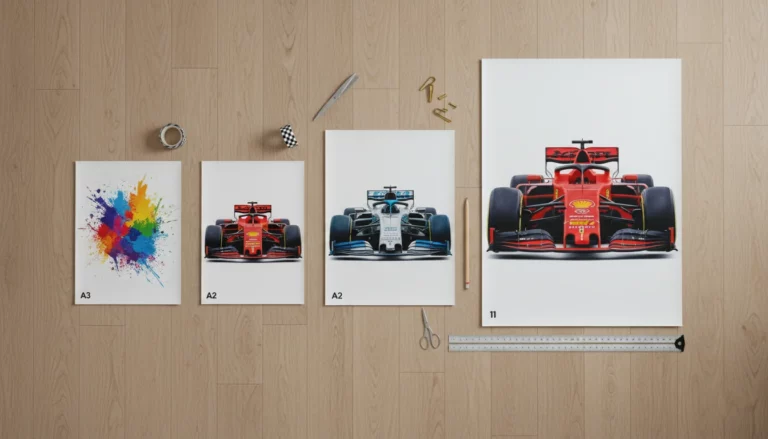
Celebrate the legends of Formula 1 with premium F1 driver posters from Poster Print Base. From Senna vs Prost to Hamilton vs Verstappen, Lauda to Mansell — printed on premium 250gsm paper, available in A3, A2, and A1 sizes, with free UK delivery on every order. Browse the full sports poster collection.
Explore more F1 content: Why Ayrton Senna Is Considered the Greatest F1 Driver Ever | Max Verstappen’s Dominance: The Records He’s Broken | A Beginner’s Guide to Formula 1 | The 10 Most Iconic F1 Liveries of All Time